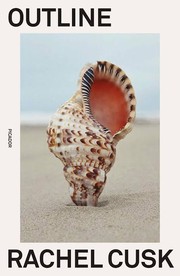
Start with Outline. A novelist teaching a writing course in Athens listens while other people talk about themselves, and she is characterised almost entirely by what she draws out of them. Her near-absence is not a stylistic tic; it is the technique the whole trilogy is built on.
Then read Transit, then Kudos, in that order and preferably close together. This is the one point in Cusk's work where order is not negotiable, and the reason is worth stating plainly: the trilogy is a method as much as a story. Each book applies the same procedure — the narrator listens, other people speak at length, and a self is implied by the shape of the negative space. Taken out of sequence you get three books of monologues. Taken in sequence you watch the withheld narrator come very slightly into focus across a thousand pages, which is the entire experience.
The trilogy, in sequence
Outline is Athens, heat and strangers, and the purest application of the method. The narrator is named once, glancingly, and readers routinely miss it.
Transit moves to London and a flat being renovated. The self that Outline withheld begins, fractionally, to appear — there are decisions, a family, neighbours who cannot be listened past. If you liked the first book, this is where you find out whether the trick has range.
Kudos is literary festivals and a Europe arguing with itself, and it closes the trilogy's argument about narrative itself: what stories are for, who gets to tell them, whether telling one is a form of aggression. Reading it first would be reading the conclusion of an argument you have not heard.
The memoirs, and where the method came from
A life's work is about becoming a mother and refusing to be grateful for it. Aftermath is about the end of a marriage. Both drew genuinely vicious reviews on publication — not mixed notices, but a level of personal hostility unusual in British literary journalism.
Read them second, after the trilogy, because in that order they are legible as the pressure that produced Outline. Read first, they are simply two bruising memoirs by a writer you do not yet know.
The early fiction
Arlington Park takes a single day in the lives of several women in a London suburb. It is recognisably the same intelligence at work in a far more traditional form — omniscient, ironic, closer to the English social novel she later abandoned. Worth reading precisely because it shows what she gave up.
After the trilogy
Second Place has a woman invite a famous painter to stay, with catastrophic results. It is loosely drawn from Mabel Dodge Luhan's memoir of D. H. Lawrence, and it is the strangest thing she has written — closer to a fable than to the trilogy, and it divides readers sharply.
Where to stop
Three books, in order, and you have read the thing Cusk is known for. Most readers should stop there or add Arlington Park for contrast.
The one order mistake worth avoiding: do not begin with the memoirs on the theory that they come first chronologically. They are the harder books, they are about their own reception as much as anything, and they read entirely differently once you know what the trilogy did with the same material. Browse more literary reading paths on Discover.
Follow the full ordered path here: Rachel Cusk Reading Order: The Outline Trilogy and Where to Start.