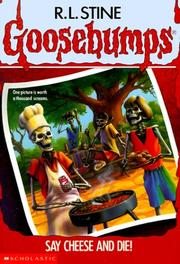
Start with Welcome to Dead House. It is Goosebumps #1, published in 1992 at 144 pages, and it happens to be both the first book and one of the four best: a family inherits a house in a town where everyone is already dead, and no adult believes the children. After it, read Say Cheese and Die!, Night of the Living Dummy and The Haunted Mask.
Those four are what people mean when they say Goosebumps, and putting them first is a deliberate departure from series numbering. The original Goosebumps books are almost entirely standalone — no continuing characters, no arc, no cliffhangers between volumes — so the numbers on the spine are a publication record, not a reading order. Once you are past the opening four, this path does switch to publication order, because the books after that are best read as a run rather than ranked.
The four to start with
Welcome to Dead House is unusually bleak for the series and sets the template. Say Cheese and Die! is the cleanest single premise Stine ever built — a camera that photographs the future — and the best demonstration of his actual craft: one rule, applied relentlessly, with a shock at the end of nearly every chapter. Night of the Living Dummy introduces Slappy the ventriloquist dummy, the closest thing the series has to a recurring villain and the reason it ran for thirty years; it spawned a long sub-series of its own, none of which is on this path. The Haunted Mask is the best-written of the early run, because Carly Beth's fear is about her own timidity rather than about a monster.
All four run between 141 and 144 pages. A confident nine-year-old finishes one in an evening.
The rest of 1992 and 1993
Now go in order: Stay Out of the Basement (#2, 128 pages), the series' first body-horror premise and much stranger than its cover suggests; Monster Blood (#3), a one-joke idea Stine liked enough to sequel four times; The Curse of the Mummy's Tomb (#5), the clearest borrowing from adult horror movies and one of the few books set outside suburbia; and Let's Get Invisible! (#6), the best-constructed of the second tier and a fair test of whether you want the whole run.
The middle run, and where to stop
Three more: Welcome to Camp Nightmare (#9), which has the most ambitious twist Stine attempted; The Werewolf of Fever Swamp (#14), a conventional monster story with a whodunnit underneath it; and The Scarecrow Walks at Midnight (#20).
Stop there. This path covers eleven of the sixty-two originals and ends at number twenty on purpose. From roughly that point the premises begin repeating, and the sequels, the Goosebumps 2000 relaunch and the later reboot lines are for completists. Reading all sixty-two is a hobby, not a reading order.
Fear Street, for a reader who has outgrown Goosebumps
Fear Street is the older, bloodier series Stine was already writing before Goosebumps existed. Start with The New Girl, published in 1989 — three years before Goosebumps #1 — which establishes Shadyside and the tone. Then Fear Street - The Surprise Party, the second book and the clearest early statement of the formula: a group of teenagers, a secret from a year ago, and someone picking them off. Finish with Fear Street Novel - Party Games, the 2014 relaunch, written twenty-five years later for the readers who grew up on the originals. It runs 283 pages against the originals' 167, and our record for it credits Brittany Pressley alongside Stine, which indicates an audiobook edition rather than a second author.
A note on the records themselves
Several of our Goosebumps records are non-English editions of the right book: the ISBNs we hold for Night of the Living Dummy, Stay Out of the Basement and The Werewolf of Fever Swamp are German-language ones, and Let's Get Invisible! is French. The buy links follow the record, so check the language before ordering those four. Stine is also filed throughout our catalogue under his full name rather than the initials on the cover.
The full ordered list, with every record and its length, is at the R.L. Stine path.