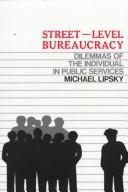
Start with Bureaucracy. James Q. Wilson's 1989 study of what government agencies do and why — built on close comparison of prisons, armies, schools and regulators — is the single most useful book on this subject, and its central point organises everything after it: public agencies are judged on their procedures because their outputs are hard to measure. Follow it with Street-level bureaucracy, Michael Lipsky's 1980 argument that policy is in practice made by the caseworkers, police officers and teachers who ration their own time under impossible demand. That is the view from the counter, and it explains the gap between what a statute says and what a citizen receives.
The thing to know before buying anything is that a good part of this field is textbook territory, and the editions matter more than in most subjects. Several titles below are course texts, revised every few years with the American institutional detail updated each time; a fifteen-year-old copy is cheap and will describe personnel rules, contracting practice and federal programmes that have changed. Our catalogue records are frequently early editions. Where a book is a classic monograph rather than a course text, the old edition is usually fine.
How agencies actually behave
After Wilson and Lipsky, read The case for bureaucracy third, as the deliberate rebuttal. Charles Goodsell assembles the survey and performance evidence that citizens rate their actual encounters with government far better than they rate government in the abstract. It is a short polemic with data attached, and the record here is an early edition.
The field's foundations, and which are course texts
Public administration is the standard survey text, written for a course, and organised around David Rosenbloom's three competing approaches — managerial, political and legal. The framework is the contribution: it explains why reformers from different traditions keep talking past each other. Our record is a mid-1980s edition and the book has since been through many more, so buy current. Classics of public administration is the field's standard reader, again assembled for classroom use — Woodrow Wilson's 1887 essay, Weber on bureaucracy, Taylor, Gulick, Simon, Lindblom, in the original. Read it after Rosenbloom, who tells you why the pieces matter before you meet them cold; later editions swap some selections.
Administrative behavior is not a textbook. It is Herbert Simon's 1947 monograph, the origin of bounded rationality and satisficing, and the work behind his Nobel in economics — the most demanding book in this stage and the most rewarding, because it demolished the assumption that administrators optimise. The politics of the administrative process is a contemporary course text on personnel systems, contracting, federalism and accountability in current American practice, revised frequently, so check the edition.
Decisions, implementation and money
Essence of decision is Graham Allison's three competing models of the Cuban Missile Crisis — rational actor, organisational process, bureaucratic politics — and the best demonstration that what an institution does is not what any individual chose. The lenses are reusable on any case. Note that the 1999 second edition with Philip Zelikow is a substantial rewrite drawing on Soviet and Cuban archives; our record is the 1971 original. Implementation is Pressman and Wildavsky on a federal jobs programme in Oakland, and it founded implementation studies by counting the separate approvals a policy needed and doing the arithmetic of clearance points. Short, and the most quietly devastating book here. The new politics of the budgetary process follows from the same author for the money side: budgeting as an incremental, political and repeated game rather than an analytical exercise. Dated in its particulars, still correct about the behaviour.
Reform, and why it keeps failing
Reinventing government is the 1992 bestseller behind the New Public Management wave and the Clinton-Gore reinvention effort. Read it as the high-water mark of a movement whose record can now be assessed, and read Wilson against it. Creating public value is the more durable half of that era: Mark Moore's strategic triangle asks a public manager to define the value created, secure legitimacy and support, and confirm operational capacity. It is still taught and still used, which is more than most reform writing of that era can claim. Recoding America is the modern case study from Jennifer Pahlka, founder of Code for America and a former US deputy chief technology officer, on why government software fails — effectively Pressman's clearance points in a digital era. Her argument for pushing discretion downward is a position, not a consensus. Why Nothing Works is the most recent and most contentious: Marc Dunkelman argues that a progressive distrust of centralised power created so many veto points that public projects can no longer be built. Read it last and read it as an argument; the overlapping Abundance by Ezra Klein and Derek Thompson is not on this list, and both are political interventions as much as scholarship.
Follow the full ordered path here: Public Administration: The Best Books on How Government Runs, in Order.