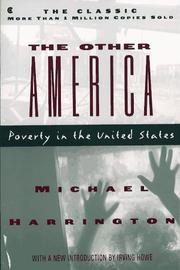
Start with The other America. Michael Harrington's 1962 book is credited with putting poverty back on the national agenda, and his argument — that forty million poor Americans had become invisible to an affluent society — is the origin point for nearly everything written since. Harrington was a democratic socialist and the book is polemic as much as reportage, which is worth knowing going in.
The argument about American poverty has been running in roughly its present form for sixty years. On one side sit structural accounts, which locate the cause in labour markets, housing, race and policy design. On the other sit behavioural and cultural accounts, which locate it in family formation, work attachment and the incentives created by assistance itself. This path is built so you meet both in their strongest form, and every book below is flagged with where its author stands. It does not tell you which is right.
The books that made poverty visible
Nickel and Dimed is Barbara Ehrenreich, a self-described socialist with a science doctorate, working as a waitress, cleaner and Walmart associate in 1998 to test whether low-wage work covers low-wage living. It turns Harrington's abstraction into arithmetic, and carries a persistent criticism: a journalist who can leave is not in the position of someone who cannot.
Hand to Mouth is the answer to that objection, written from inside rather than from a visit. Linda Tirado was working poor when a post of hers went viral, and the book expands it — angry, unsystematic, deliberately so, and the best short account of why decisions that look self-defeating from outside are rational from within.
The modern close-ups
Evicted is the book that reset the field. Matthew Desmond, a sociologist, followed eight Milwaukee families and their landlords, and argues that eviction is a cause of poverty rather than only a symptom of it — that housing instability actively produces job loss, school disruption and depression. $2.00 a Day makes a different claim: Kathryn Edin and H. Luke Shaefer find a growing number of American households living on almost no cash income at all, and attribute it substantially to the 1996 replacement of cash welfare with work-conditioned benefits. Their finding is not Desmond's finding and does not depend on it, and the two-dollar threshold itself has been contested on measurement grounds by economists who argue it undercounts in-kind benefits.
Invisible Child is Andrea Elliott's eight years reporting on one homeless girl in New York — the longest time horizon here, and the clearest picture of how poverty, foster care, schooling and addiction interlock across a childhood.
The structural account
The truly disadvantaged comes first in this stage because it is the structural argument's foundational text. William Julius Wilson, a liberal sociologist, argued that concentrated urban poverty followed the disappearance of manufacturing work and the out-migration of middle-class Black families rather than a culture of dependency; his later When Work Disappears extends it with fieldwork. Regulating the poor is Frances Fox Piven and Richard Cloward's radical-left thesis from 1971: relief expands to quell disorder and contracts to enforce low-wage work. It has been attacked frequently and it frames welfare as labour discipline, a claim you will meet again in every later argument.
The working poor is David Shipler, a liberal journalist unusually willing to describe structural traps and individual choices within the same life, and it bridges the two halves of the path. Poverty, by America is Desmond's follow-up to Evicted and his most polemical book: the claim is that American poverty persists because non-poor Americans benefit from it through tax expenditures, labour costs and land use. Read it as an argument written to persuade, not as a survey — and note that it is a different argument from the one Evicted makes.
The behavioural account, and the history of the quarrel
Losing ground is the most influential conservative book on the subject. Charles Murray, a libertarian scholar then at the Manhattan Institute, argued that Great Society programmes worsened the outcomes they targeted by changing incentives; the data and the causal claims have been contested at length, and the book is here because it shaped a generation of policy. His later Coming Apart makes a related argument about class divergence among white Americans. Beyond entitlement is Lawrence Mead's paternalist case that assistance should carry work obligations, and it supplied much of the intellectual basis for the 1996 reform — drier and more careful than Murray, and the clearer statement of the position.
American Dream is the empirical test of what those two books produced: Jason DeParle followed three Milwaukee women through welfare reform and reaches an unresolved verdict, that work went up and poverty did not go away. The undeserving poor closes the path with Michael Katz on how Americans have sorted the poor into deserving and undeserving since the nineteenth century. One well-known book is not on this list: J.D. Vance's Hillbilly Elegy, the cultural-explanation memoir most read in the last decade, has no record in our catalogue — worth knowing if you want that argument in its popular form. More on Discover.
Follow the full ordered path here: Poverty in America: The Best Books on Who Is Poor and Why.