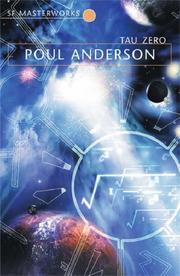
Start with Tau Zero if you came for science fiction and The broken sword if you came for fantasy. Poul Anderson published for fifty years and wrote two more or less separate careers — rigorous hard SF built around a single physical idea followed to its conclusion, and Norse and medieval fantasy written in a deliberately archaic register. Readers who bounce off him have almost always started in the wrong half.
Tau Zero is the standard recommendation and the best argument for him: a starship that cannot decelerate, relativistic time dilation taken to its limit, and a crew who have to live inside the consequence. The broken sword is a bleak Norse-saga novel of changelings, elves and a cursed blade, published in 1954, the same year as The Fellowship of the Ring and utterly unlike it. Read the original 1954 text if you have the choice; Anderson revised it in 1971 and most readers prefer the first version.
Almost nothing here is compulsory reading in a fixed order. Most of the books stand alone, so this is a route rather than a sequence, and the only stage where order genuinely matters is the Technic History.
The other opener, and the light strand
Brain Wave was his first novel and has one of his best premises: Earth leaves a field that has been suppressing intelligence, and every mind on the planet, human and animal, sharpens overnight. It is short, and it shows Tau Zero's method applied to biology and society instead of physics.
The High Crusade has an alien scoutship land in fourteenth-century England and the local baron capture it. It is deadpan, fast, and the most purely enjoyable thing he wrote. Three Hearts and Three Lions throws a Danish engineer into a Carolingian world of Law and Chaos, and matters historically as well: its troll, its paladin and its Law-and-Chaos axis fed directly into early Dungeons and Dragons. Operation Chaos is a fix-up set in a modern America where magic is an engineering discipline, and the joke lands hardest once you have seen him do systems-building straight.
The Technic History, in internal chronology
This is the one that confuses people. The Technic History is a fix-up assembled from stories written across decades and reprinted in several incompatible orders, so publication order is close to meaningless. Read it in internal chronology: the merchant era of the Polesotechnic League first, then the decadent Terran Empire of Dominic Flandry.
The Man Who Counts is the correct start — three humans stranded on a hostile world with nothing but a fat merchant's talent for negotiation. It is frequently reprinted as War of the Wing-Men, which is the same book. Trader to the stars is three van Rijn novellas establishing how the League actually works, with the ethics of trade-as-contact left uncomfortably open. The earth book of Stormgate is the big League collection, framed as an in-universe anthology compiled centuries later, which is the first sign the era is being looked back on rather than lived in. The people of the wind is the hinge: a war between the young Terran Empire and the Ythrian Domain, with neither side made wrong. Ensign Flandry opens the second half — an intelligence officer serving an empire he knows is dying, buying time rather than winning. The tone shift from van Rijn to Flandry is the whole point of reading them this way. The Baen omnibus series The Technic Civilization Saga collects the sequence in this chronology if you want it in seven volumes.
The Norse strain and the long books
Hrolf Kraki's Saga is a straight retelling of the legendary Danish saga that shares source material with Beowulf, in a plain saga voice with no fantasy softening — the natural next step after The broken sword. War of the Gods and Mother of Kings continue that strand.
The time patrol collects the stories where his historical reading and his SF discipline finally meet, with agents preserving a timeline across periods he clearly knew in detail; an earlier selection of the same material is catalogued as The Guardians of Time, so one purchase covers the core. The boat of a million years is the late masterpiece and the right book to finish on: a handful of accidental immortals traced from the Phoenicians to interstellar flight, which lets him write historical fiction and hard SF inside one novel. Genesis and Harvest of Stars go further into the far future if you want more of the late work.
More science fiction reading orders are on Discover.
Follow the full ordered path here: Poul Anderson books in order: where to start.
Ready to learn something deeply?
Build a reading path — free