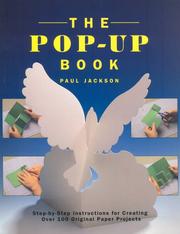
Start with The pop-up book by Paul Jackson and build from it before you read anything else. It holds around a hundred projects with templates, arranged from a single slit upward, and the mechanisms need to be in your hands before the design books mean anything. Paper engineering is one of the few crafts where reading ahead of making is actively counterproductive: a v-fold described on a page is abstract, and a v-fold you have cut wrong twice is a piece of knowledge.
The field is small and unusually well defined. A handful of designers have written almost all of it, and their books divide cleanly into three kinds: mechanism catalogues, technique manuals, and the wider discipline of folding that pop-ups sit inside. Expect a great deal of Paul Jackson and Duncan Birmingham on this list — that is not narrow curation, it is what the field has published.
Build before you design
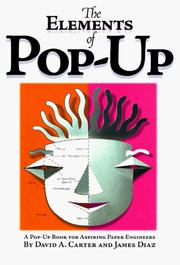
Pop-up by Ruth Wickings is a short make-it book aimed at beginners and children, and its catalogue record is only sixteen pages, so treat it as a fast confidence pass through the core mechanisms rather than a reference. The elements of pop-up is the mechanism dictionary and is itself a pop-up book: every mechanism is demonstrated as a working model on the page describing it. Take David A. Carter third, once you have built enough to recognise what you are looking at, and it becomes a permanent reference rather than something you read once.
Designing your own mechanisms
Cut and Fold Techniques for Pop-Up Designs is the bridge. Same author as your first book, but organised as drills on cutting and folding accuracy rather than as projects, and accuracy is precisely what separates a crisp pop-up from a wobbly one.
Pop-Up Design and Paper Mechanics is the standard design manual: Duncan Birmingham groups mechanisms by how they work and explains the geometry so you can vary them rather than copy them. It is a re-issue of his earlier Pop Up! A Manual of Paper Mechanisms, which resolves as a separate record in this catalogue — buy one, not both. Paper Engineering for Pop-Up Books and Cards is older and slimmer at around fifty pages, and remains the clearest short treatment of card mechanisms specifically; read Mark Hiner alongside Birmingham, because the two describe the same folds differently and one of the two usually clicks.
The pocket paper engineer teaches one mechanism family at a time with pre-scored models you assemble, and Carol Barton is the most patient writer here on the step almost everyone skips: making a proper dummy before committing to a design. It is a workbook to keep open while designing rather than a book to finish.
Folding as a discipline
Folding Techniques For Designers From Sheet To Form is Jackson's systematic survey of folding for designers working in any material, and it is the book most likely to change how you look at a sheet of paper. It comes after the mechanism books because it assumes you already care about fold geometry; note that the record here carries the fuller published title. Complete Pleats goes deep into pleated structures, which produce the most striking large-scale pop-up effects and are the hardest to score accurately — read it only after Folding Techniques, which sets up its vocabulary.
Origamic Architecture is Masahiro Chatani, who invented the cut-and-fold architectural card made from a single sheet with no glue and no added parts. Working inside that constraint is the fastest way to improve fold planning, which is why an adjacent discipline earns a place on the path.
Paper, production and a finished book
Structural Packaging teaches you to design a folded container from first principles instead of copying a net, and the discipline transfers directly: both a carton and a pop-up are flat sheets that must become rigid three-dimensional objects and then survive handling. Playing with Paper widens the material vocabulary — translucency, weight, grain direction, lighting — and is the right book when your engineering is sound but your pieces still look flat. The Papermaker's Companion is optional for most readers; it is here because grain and fibre are the two properties that most often ruin an otherwise correct fold, and making a sheet teaches them faster than reading about them does.
Encyclopedia Prehistorica Dinosaurs is not a manual at all. It is a commercially produced Robert Sabuda and Matthew Reinhart pop-up, and it is the final exercise: open it slowly, work out which mechanism from Carter's dictionary each spread is using, and you will have read the path backwards. Build your own reading list at /create.
Follow the full ordered path here: How to Learn Paper Engineering and Pop-Up Design from Books.