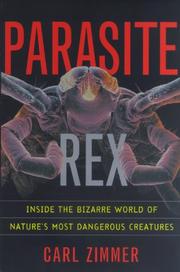
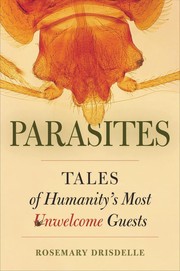
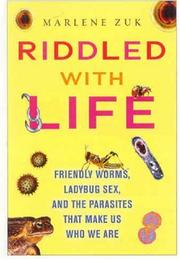
Start with Parasite Rex. Carl Zimmer's book is what made parasitology popular reading, and its argument still organises the field for general readers: parasites are not degraded simplifications of free-living animals but among the most specialised organisms alive. No background is assumed. Follow it with Parasites, filed in our catalogue under the bare title, in which Rosemary Drisdelle — a clinical parasitologist — gives the human-facing companion, case by case. Then Riddled with Life, in which Marlene Zuk reframes disease as a permanent evolutionary partner rather than an accident, and starts moving you from natural history toward theory.
Be clear about the split ahead. The first two stages are trade books written for anyone. The third stage is undergraduate and graduate textbooks that assume a year of college biology — cell structure, basic immunology, comfort with taxonomy and life-cycle diagrams — and reading them without that is possible but slow. Nothing here is medical advice: the clinical books describe how infections are diagnosed and treated, and if you think you have a parasitic infection that is a doctor's problem, not a reading problem.
Manipulation of the host
This is your brain on parasites is the accessible treatment of behavioural manipulation, including Toxoplasma gondii and the claims about its effects on human behaviour. Kathleen McAuliffe is more careful with the human evidence than her subtitle suggests, and the caution she models is the correct posture — the animal work is solid, the human work is a contested literature with real replication problems.
Plight of the living dead covers the invertebrate cases species by species: parasitoid wasps, hairworms, the zombie-ant fungus. Matt Simon is funnier and more specific than McAuliffe, and these are the examples where the mechanism is actually understood rather than inferred.
The discipline, properly, and the edition problem
Foundations of parasitology — the Schmidt and Roberts text — is what most undergraduate courses are built on, with broad taxonomic coverage of protozoa, trematodes, cestodes, nematodes and arthropods. Work through it rather than reading it straight. One caution: our catalogue record is an early edition from 1977, and the book has been substantially revised many times since. Buy the current edition, because taxonomy, drug names and distribution maps all move.
Human parasitology by Burton Bogitsh is narrower and organised around the parasites that infect people, so it is the better text if your interest is medical rather than zoological; read it alongside Schmidt and Roberts, not after. Parasitism is the ecological text — populations, communities, transmission dynamics — and the point where parasitology stops being a catalogue of organisms and becomes a science of interactions. The Art of Being a Parasite is the most conceptually satisfying book on the list: Claude Combes treats parasitism as a set of engineering problems — find a host, get in, stay, get out — and it is the bridge into the evolutionary material.
Evolution, and the diseases
Evolutionary parasitology is the graduate synthesis of parasite ecology, immunology and evolution. At over 500 dense pages it is the single most demanding book here; take it only after Combes has given you the framing. Evolution of infectious disease is Paul Ewald's argument that transmission mode selects for virulence — the one idea from this field that changed public-health thinking. It is contested in places, so read it as a strong hypothesis with an unusual amount of evidence behind it rather than as settled fact.
Then the clinical and historical closers. Parasitic diseases by Dickson Despommier is the reference for human parasitic infection, organised by organism with the diagnostic and treatment picture; our record is an older edition, and later editions have been distributed free, so look for the current one before buying. The fever : how malaria has ruled humankind for 500,000 years is Sonia Shah on why the most-studied parasitic disease has resisted a century of eradication campaigns. Finish with The Mosquito, on the vector rather than the parasite — Timothy Winegard's grand historical claims are sweeping and sometimes overreach, so read it for the vector biology and apply the scepticism the rest of this path has been teaching.
Work through the full path in order and the jump from trade book to textbook stops being a cliff.
Follow the full ordered path here: Best Books on Parasites and Parasitology, from Popular Science to Textbook.