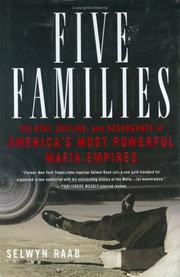
Start with Five Families. Selwyn Raab covered the New York families for the New York Times for decades, and at nearly 800 pages his book is the standard narrative frame that everything else in the American section sits inside. Then, if you only read one more book on this subject, make it The Sicilian Mafia — Diego Gambetta's argument that a mafia's product is private protection, sold where the state cannot supply trust. It reframes every story in the popular literature, which is why it comes after them and not before.
The reason this subject needs an order is that its most famous books are not the same kind of object. Some are reported journalism, some are academic history, and several are as-told-to memoirs by men with strong reasons to shape how they are remembered. A mobster's account is good evidence about how mobsters talk and poor evidence about how the organisation works. Real, named people are involved throughout, so the useful discipline is to hold each book to what it documents.
The American story, and how much of it to believe
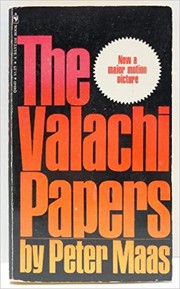
The Valachi Papers is the 1968 book built on Joseph Valachi's testimony — the first insider account, and the one that put the phrase Cosa Nostra into public circulation. Read it as a primary document and a contested one: historians have long disputed how much of Valachi's picture of a single national structure describes the organisation and how much reflects what his federal handlers were looking for.
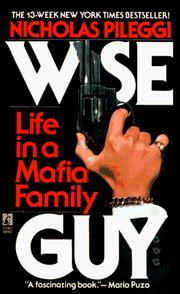
Wiseguy is Nicholas Pileggi's account of Henry Hill's life as an associate, and it remains the most vivid description of the day-to-day economics — the earning, the tribute, the constant hustling. Hill later acknowledged embellishing, so read it for texture rather than fact, which is what it is best at anyway. The Martin Scorsese film made from it, and Mario Puzo's novel The Godfather, did more than any book to fix the mafia's image, including the mafia's image of itself; neither is a source and neither is on this path.
The business of crime is the corrective. Humbert Nelli's history of Italian-American organized crime from 1890 to 1940 argues directly against the imported-conspiracy model Valachi's testimony encouraged. It is dry, short and academic, and it shows how much of the popular story is a construction.
Sicily and Italy
Cosa Nostra by John Dickie is the standard scholarly history of the Sicilian mafia from 1860, and the single most reliable narrative on this list. Read it before anything else on Italy — it dismantles the romantic material as it goes. Excellent Cadavers is journalism built around the magistrates Giovanni Falcone and Paolo Borsellino and the maxi-trial, ending with their murders in 1992; our catalogue holds it under a truncated display title.
Midnight in Sicily is literary reportage rather than history: Peter Robb lived in southern Italy for years and moves between food, art, politics and the trials without separating them. It assumes the chronology Dickie supplies.
Gomorrah needs stating plainly. Roberto Saviano's account of the Camorra as a business empire in waste, concrete and couture has kept him under police protection since 2006. Its status is genuinely contested: it is written as reportage but uses composite scenes and a first-person narrator who is sometimes a device, and specific claims have been disputed in court by named parties. Read it as testimony about a system rather than as a documentary record.
Crime as an industry, and the global picture
Mafia Brotherhoods is Letizia Paoli's study of Cosa Nostra and the 'Ndrangheta from judicial records, and the strongest counter to Gambetta: she holds these are ritual kinship organisations with political ambitions, not firms. The two positions are a real dispute — read both and take a side. Mafias on the move turns it into an empirical question, with Federico Varese testing why mafias transplant successfully to some territories and fail in others across Italy, the United States, Russia and China.
Finish wide. McMafia is Misha Glenny's post-Cold-War survey of Balkan smuggling, Russian privatisation, Nigerian fraud and Asian networks. The Vory is Mark Galeotti on Russian organized crime from the gulag to its entanglement with the modern state — the best book in English on the subject, and a good check against Varese's Russian chapters. El Narco closes with Ioan Grillo on the Mexican cartels as an insurgency with a business model, which is the clearest live case of what Gambetta's theory predicts.
Follow the full path in order and you will know, for any claim about organized crime, whether the book making it could possibly know.
Follow the full ordered path here: Organized Crime and the Mafia: Which Books to Trust, and in What Order.