Start with When Death Becomes Life. Joshua Mezrich is a working transplant surgeon, and his 2019 book alternates his own cases with the history of the field, so you get the operation and its origins in one pass. It is the only book here that assumes no background at all. It was published in Britain under a different title, which is the same text in another edition.
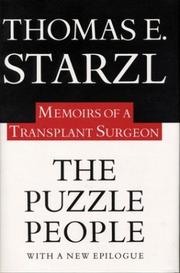
Then the two books written from inside the field's own history. The puzzle people is Thomas Starzl's 1992 memoir — the surgeon who made liver transplantation survivable, writing as a primary source rather than a popular author, and unusually candid about how many patients died before the operation worked. Transplant by Nicholas Tilney is a Harvard surgeon's history from the inside, more measured than Starzl and stronger than Mezrich on the science of rejection and immunosuppression specifically. None of these is clinical guidance: they are memoir and history, and nothing here tells you how listing, matching or allocation works where you live.
A warning about the titles
Two entirely different books on this path are called Spare Parts, by different authors, published thirty years apart. Both are worth reading and neither is a revision of the other. Paul Craddock's 2021 book is popular history covering four centuries from seventeenth-century blood transfusion and tooth transplants onward, and it is the widest historical frame available in one accessible volume. Renée Fox and Judith Swazey's 1992 book is sociology, and is discussed further down. Check the author before you order.
Alongside Craddock, Flesh and blood by Susan Lederer is the academic history of transfusion and transplantation in twentieth-century America. It is much more interested than Craddock in race, consent, and how the public came to accept moving body parts between people — scholarly prose, but not technical.
The ethics, and who is making each claim
The courage to fail is the foundational sociological study of transplantation and dialysis, written by Fox and Swazey in 1974 while the field was still experimental. Most of the vocabulary later ethicists use starts here. Their 1992 Spare Parts is the sequel in which two scholars who had spent three decades studying the field publicly withdrew from it, arguing that transplantation had outrun its own ethics — that is their position, stated as such, and it was contested at the time.
Defining Death by Robert Veatch and Lainie Ross is the most technical entry: a philosopher's treatment of the brain-death criterion that nearly all deceased donation rests on, and a demonstration of how contested a settled-looking definition is. The ethics of organ transplants, edited by Arthur Caplan, is a survey collection on consent, presumed consent, living donation and payment — read it for the range of defensible positions before the argument books.
Scarcity, allocation and the market
Raising the Dead builds each chapter around a real case and argues the ethics out of it; it is the most readable bridge between the academic and journalistic material. Strange Harvest is Lesley Sharp's anthropological fieldwork on how donor families, recipients and procurement staff actually talk about organs — the letters, the rituals, the language of the gift.
The last two make serious, specific accusations, and it matters whose they are. In The Organ Thieves, Chip Jones reconstructs the 1968 heart transplant at the Medical College of Virginia in which, on his account, the organs of a Black man, Bruce Tucker, were taken without his family's consent; a lawsuit followed, and Jones argues the case reflects a wider pattern in how Black patients were treated by that institution. Read it as his documented case, not as a general finding. The red market is Scott Carney's reporting on the international trade in kidneys, blood, bones and bodies; his sourcing is journalistic and his framing is occasionally sensational, and the path's own note says so. It is the right closing book precisely because everything before it describes a system designed to prevent what Carney says he found happening anyway.
Follow the full path in order and the distinction between a surgeon's memoir, a sociologist's finding and a reporter's allegation will stay clear — which on this subject is the whole point.
Follow the full ordered path here: How to Learn About Organ Transplantation from Books, in Order.