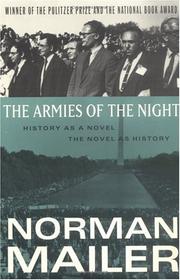
Start with The armies of the night. It is short, it is his best sustained piece of writing, and it does in two hundred pages what the rest of the nonfiction spends decades circling: it puts a character called Mailer, written in the third person, at the centre of a real public event and reports on both.
The obvious alternative is The Naked and the Dead, the war novel he published at twenty-five. It made his name and it is a competent, conventional book that reads almost nothing like the writer he became. Starting there gives you a false impression of what you are signing up for.
The nonfiction, which is the real body of work
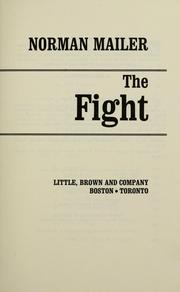
After The armies of the night, read The Fight. It is his account of the Ali–Foreman bout in Zaire, it is a hundred and some pages, and the prose is looser and more enjoyable than anything else he wrote. Miami and the siege of Chicago is the political-convention book from the same period and the same method.
Of a fire on the moon is the hardest of the four. It is the Apollo book, and Mailer's inability to find a purchase on engineers and telemetry is itself the subject. Some readers think it is his most interesting failure; others give up at the technical chapters. Both reactions are fair.
Then The executioner's song, which is the summit. It is over a thousand pages on the murders and execution of Gary Gilmore, and the astonishing thing about it is that the Mailer persona is completely absent — flat, patient, third-person prose sustained at enormous length. Readers who cannot stand him usually make an exception for this one.
The fiction, in descending order of reliability
The Naked and the Dead belongs here rather than at the front. Advertisements for myself is a scrapbook of stories, fragments and self-assessment that functions as his manifesto; it is uneven by design.
An American Dream is the most contested book he wrote. Its protagonist murders his wife in the opening chapters and the novel proceeds without straightforward condemnation. Readers divide hard on whether it is a serious moral experiment or something worse, and that argument has been running since publication without resolution. Why are we in Vietnam? is a short, profane monologue that has aged into a curiosity.
Ancient Evenings is the long Egyptian novel and is generally considered his largest miscalculation. Harlot's ghost runs to thirteen hundred pages of CIA history and ends with the words TO BE CONTINUED; the continuation never came, which readers should know before committing. The Castle in the Forest, his last novel, narrates Hitler's childhood through a demon and is a stranger, tighter book than its late position suggests.
What to do about the man
Mailer's biography includes his stabbing of his second wife, Adele Morales, in 1960, to which he pleaded guilty, and his advocacy for the parole of Jack Abbott, who killed a man weeks after release. Neither fact is in dispute. How much weight they should carry when reading the books very much is, and readers have taken every available position on it. State the facts, decide for yourself, and be sceptical of anyone who tells you the question is easy.
Where to stop
Most readers should read the four nonfiction books and The executioner's song and stop. The novels are for people who have decided they want the whole writer. If you want to see the full arrangement, including where the minor titles sit, follow the path below or browse more author paths on our discover page.
Follow the full ordered path here: Norman Mailer in Order: Where to Start with a Vast, Uneven Bibliography.