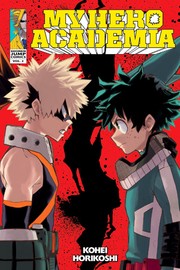
Start with My Hero Academia, Vol. 1 and read by volume number. Kohei Horikoshi's series ran in Weekly Shonen Jump from 2014 to 2024 and the collected volumes follow the serialisation exactly, so there is no publication-versus-chronological argument to have. Volume one introduces Izuku Midoriya, a boy born without a superpower in a world where almost everyone has one, and the hero who chooses him.
The only genuine ordering questions are the spin-offs and the anime. Neither should change where you begin.
The main sequence
Straight through: My Hero Academia, Vol. 1 through to the end. Our catalogue holds volumes one to eight, then ten, eleven and twelve, then fourteen, then sixteen.
Those gaps are ours, not the series'. Volumes nine, thirteen and fifteen are part of the story and must be read in place — the series does not skip, and reading eight straight into ten will lose you a full arc. Source the missing volumes elsewhere and slot them in where they belong. Our list also stops at sixteen; the complete run is forty-two volumes.
Where the series actually starts working
My Hero Academia, Vol. 1 is setup, and it is the weakest volume in the run: the art is rougher than it later becomes, the premise takes most of the book to install, and the pacing is uneven. This is normal for long shonen series and it is worth knowing before you judge the whole thing on it.
Most readers find it clicks during the U.A. Sports Festival, which runs from about My Hero Academia, Vol. 3 to around My Hero Academia, Vol. 5 — a school tournament arc that introduces most of the supporting cast properly and gives several of them real motives. If you are unsure after volume one, read to five before deciding. If it has not taken by then, it will not.
My Hero Academia, Vol. 6 and My Hero Academia, Vol. 7 raise the stakes considerably and the tone darkens from there; the series does not stay a school comedy.
The spin-offs, and when to read them
My Hero Academia: Vigilantes is the substantial one — a fifteen-volume series written by Hideyuki Furuhashi and drawn by Betten Court, set slightly before the main story and following unlicensed heroes operating outside the law. It is well regarded and it is genuinely a prequel, but do not read it first. It assumes you know how hero licensing, quirks and the professional hierarchy work, and several of its best moments depend on recognising characters from the main series. Read it after you are ten or so volumes in, or after you have finished.
Team-Up Missions is light and non-canonical in effect, and the School Briefs light novels are side stories. Both are optional at any point.
If you have watched the anime
This is the most common question and the answer is not a volume number. The anime adapts the manga closely but seasons do not line up neatly with volumes — a season covers roughly four to six volumes depending on pacing and inserted material. Rather than guessing, find the chapter number the last episode you watched adapted, then pick up the volume containing the next chapter. Guessing by volume usually means re-reading a third of a book or skipping an arc.
Where to stop
There is no good early exit. The series is one escalating story and the arcs hand off to each other directly rather than resolving. The most defensible stopping point in the early run is the end of the Sports Festival around My Hero Academia, Vol. 5, which does conclude a self-contained tournament.
Most readers rate the middle of the run above both ends: the early volumes are learning the world and the final arcs are consequence. If you get past volume ten you will almost certainly finish. Browse more manga reading orders on Discover, or see the My Hero Academia hub.
Follow the full ordered path here: My Hero Academia Reading Order: Where to Start and What Order to Read It In.