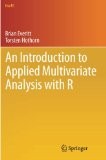
Start with Brian Everitt and Torsten Hothorn's An introduction to applied multivariate analysis with R, not with a theory text. Multivariate methods are close to impossible to understand from formulas alone, because what they do is geometric — rotating, projecting and grouping a cloud of correlated variables — and the fastest way to see that is to fit one to a dataset and look at the output. Everitt introduces each method with data and the R code that fits it. The prerequisite is ordinary regression and enough R to run a script.
The reason order matters here is that the field is really two literatures that rarely cite each other. One is applied, written for psychologists, biologists and market researchers around software and reporting conventions. The other is a matrix-algebra course taught in statistics departments, where the same methods are consequences of the multivariate normal distribution. Readers who start in the second tradition without the first usually learn to derive results they cannot interpret. This path runs applied first, then the standard course, then techniques one at a time, then the theory.
Applied entry points
Using multivariate statistics by Barbara Tabachnick and Linda Fidell is the standard reference in psychology and education — nearly a thousand pages, relentlessly practical about assumptions, screening, outliers and how to report results. Keep it open beside your analysis rather than reading it through. Multivariate data analysis is the business and marketing-research equivalent, and it is the least mathematical of the three; it overlaps the other two enough that you should take it only if your work is applied social science, and skip it if it is not.
The standard course
Richard Johnson and Dean Wichern's Applied multivariate statistical analysis is the most widely assigned multivariate course book there is, and the natural next step. Its real prerequisite is matrix algebra — eigenvalues, eigenvectors, quadratic forms — plus calculus-based probability; without those the derivations are unreadable. Alvin Rencher's Methods of Multivariate Analysis is the best-written alternative, with fuller derivations and an unusually clear treatment of MANOVA, and it works well as a second voice on any topic where the first book loses you.
A buying warning: a different and also excellent book by Wolfgang Härdle and Léopold Simar carries the identical title Applied Multivariate Statistical Analysis. It is more computational and more graphical, and stronger on modern topics. The two are easy to confuse in a catalogue, so check the authors.
The techniques, one at a time
Ian Jolliffe's Principal component analysis is the definitive monograph on the most-used method in the field, including every way it is misapplied, and almost everything later is downstream of it. Finding groups in data, by Leonard Kaufman and Peter Rousseeuw, is still the clearest account of why clustering is hard — the algorithms return groups whether or not any exist — and is the source of the silhouette and PAM methods. Timothy Brown's Confirmatory Factor Analysis for Applied Research, Second Edition marks where exploratory factor analysis stops and hypothesis testing on a measurement model begins. Rex Kline's Principles and practice of structural equation modeling follows it, since confirmatory factor analysis is the measurement half of every SEM, and Kline is unusually forthright about how weak the causal claims made from these models often are.
The theory
Multivariate analysis by Kanti Mardia, John Kent and John Bibby is the classic British theory course: compact, demanding, and the book the others argue with. It assumes real linear algebra and mathematical statistics. T. W. Anderson's An introduction to multivariate statistical analysis is the origin of most of the field's distribution theory — the Wishart and Hotelling results everything else assumes — and reads best as a primary source rather than a course text. Finish with Alan Julian Izenman's Modern multivariate statistical techniques, which connects the classical material to classification, manifold methods and regularisation, and is the bridge into statistical learning.
The full path carries the stage-by-stage notes and study questions; browse more quantitative subjects on /discover.
Follow the full ordered path here: How to Learn Multivariate Statistics from Books, in Order.
Ready to learn something deeply?
Build a reading path — free