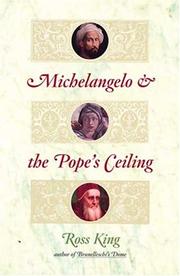
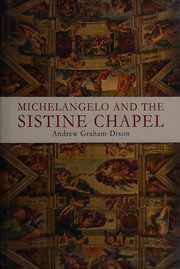
Michelangelo is unusually well documented for a Renaissance artist. Two biographies appeared in his own lifetime, hundreds of his letters survive, and so do the account books of the men who paid him — which makes the literature unusually good and also means the sources argue with each other. Start with Michelangelo and the Pope's Ceiling by Ross King, 379 pages of narrative history on four years, an artist who insisted he was a sculptor rather than a painter, and a pope who would not let him stop. It is excellent on physical practice: fresco technique, mould, the scaffold design, the arguments about money. Follow it with Michelangelo and the Sistine Chapel by Andrew Graham-Dixon, which covers the same commission but attends to what the ceiling means — its theology, its Neoplatonism, its place in the chapel's existing scheme. King tells you how it was made; Graham-Dixon tells you what it is saying.
Before going further, the practical warning that governs this whole list. Three separate and excellent books on this path are catalogued under nothing but the artist's name, and a fourth uses it with a subtitle. If you order by title you will get the wrong one. Buy by author.
Three books called Michelangelo
The first is by William E. Wallace, the leading modern Michelangelo scholar, who made his name proving from account books that Michelangelo ran a large and well-organised workshop rather than working alone as the myth insists. This is the biography for the documented life. The record shows no subtitle, a 1995 date and 268 pages, and Wallace has written several books on the artist, so check what a seller is actually shipping.
The second is by Howard Hibbard: the classic single-volume art-historical study from 1974, 347 pages, still in print and still the most efficient account of the work in relation to the life. It is shorter and more analytical than Wallace, and it is a completely different book despite the identical display title.
The third is by Anthony Hughes — the Phaidon Art and Ideas volume, 352 pages, large-format and generously illustrated, written by a scholar rather than a populariser. It is the best-value survey of the complete work and the one to keep open beside you while reading anything else here. Distinct from those three, and carrying its own subtitle, is Michelangelo: A Tormented Life by Antonio Forcellino, written by an art restorer who has physically worked on the sculpture. That gives it an unusual grasp of technique and material damage, and Forcellino is the most direct of the biographers on the religious crisis and on the relationships with Vittoria Colonna and Tommaso de' Cavalieri.
The sixteenth-century sources, and the poems
Lives of the Artists by Giorgio Vasari is the founding text of art history, written by a painter who knew Michelangelo and treated him as the summit of the whole story. Read the Michelangelo life, and Leonardo and Raphael for comparison. Every common English edition is a selection rather than the complete work, including the 320-page record here, so do not expect the full Lives.
The life of Michelangelo by Ascanio Condivi is the authorised version, dictated in effect by Michelangelo to a pupil in 1553 and published specifically to correct Vasari. It is 156 pages and should be read immediately after Vasari, because the disagreements are the point: comparing the two is the best available lesson in how an artist manages his own reputation. The Poetry of Michelangelo is James Saslow's annotated translation of more than three hundred poems with the Italian facing. Michelangelo was a serious poet, and the sonnets to Cavalieri and the late religious poems say things about desire, ageing and salvation that no biographer can supply.
Looking at the work, and the world around it
Michelangelo and the Reinvention of the Human Body by James Hall is an argument rather than a survey: that Michelangelo's treatment of the body broke deliberately with the classical tradition he is assumed to be continuing. Read it after Hughes, once you know the works well enough to test the claim. Michelangelo: The Last Judgment by Loren Partridge is a focused study of the most controversial work, the fresco whose nudes were painted over and whose artist was accused of indecency, and it models how one painting can be unpacked historically, theologically and politically.
Renaissance Rivals by Rona Goffen reads Michelangelo, Leonardo, Raphael and Titian as competitors who watched and undercut each other, and it explains commissions that make no sense without the competition. Art in Renaissance Italy by Paoletti and Radke is the standard survey textbook, organised by city and period and unusually good on patronage, guilds and the economics of commissions.
End with The Agony and the Ecstasy by Irving Stone, knowingly. It is a novel, it invents dialogue and motives freely, and its lonely tormented genius is precisely the myth that Wallace's archival work dismantles. Enjoyable on those terms and misleading on any other.
Follow the full ordered path here: The Best Michelangelo Books, and Which One Is Which.