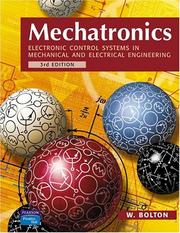
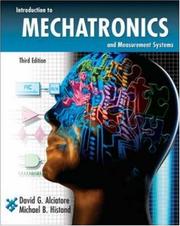
Mechatronics is less a subject than an integration discipline: it asks you to be competent in mechanical design, analogue and digital electronics, sensing, embedded programming and control theory at once, and then to reason about the whole system. The reading order follows that structure. Begin with Mechatronics by W. Bolton, the standard accessible survey and the one organised exactly along the sensor-to-actuator chain, then read Introduction to mechatronics and measurement systems by David G. Alciatore and Michael Histand, which is the more rigorous American counterpart and much stronger on circuit analysis, measurement error and instrumentation.
Nothing here formally requires more than first-year calculus and physics, but be honest about the scale. A reader with a background in one of the pillars can skip that stage; a reader with none should treat this as the work of a year rather than a month. Both survey texts are also revised often — the catalogue records shown are early printings, and course editions differ in their problem sets, so check the edition before ordering.
The electronics half
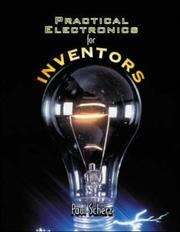
Practical Electronics for Inventors by Paul Scherz is the friendliest bridge from a mechanical background to working electronics: components, circuits, and just enough theory to stop you guessing. Start here rather than with a formal circuits textbook, which will slow you down without making you more capable.
The art of electronics by Paul Horowitz and Winfield Hill is the reference every practising engineer keeps, and it is a design book rather than a physics book — it tells you what circuits actually work and why the textbook answer often does not. One caution on this record: it is an early edition with an Indian-subcontinent publisher ISBN, and the third edition from 2015 is a substantially different and much better book. Buy the current one.
Programming Arduino by Simon Monk sits deliberately in the electronics stage rather than the software one. The fastest way to make sensor and actuator material real is to build something small this week, and Monk is the least ceremonious route to a working circuit under program control.
Sensing, actuation and the machine itself
Sensors and Actuators by Clarence W. de Silva is the systematic treatment of the transduction layer: sensor physics, error and calibration, actuator selection, and the control implications of each choice. It is the book you want once a survey course has told you a strain gauge exists and you now have to specify one.
Electric Motors and Drives by Austin Hughes and Bill Drury explains motors and their power electronics in plain engineering language, without the machine-theory apparatus that makes most texts unusable for a designer. Read it before choosing a motor for anything: the drive is usually the hard part and the part mechatronics courses skimp on. Design of machinery by Robert L. Norton is the mechanical half that mechatronics courses assume you already have — linkages, cams, gears, and the kinematic and dynamic analysis of mechanisms. A mechatronic system is only as good as the machine it actuates.
Embedded software, control, and the whole system
Making Embedded Systems by Elecia White is the best available book on embedded software as a practice rather than a syntax exercise: interrupts, state machines, memory constraints, debugging without a debugger, and firmware you can still change in a year. Read it before any control theory. Then Control Systems Engineering by Norman S. Nise, the standard and more approachable undergraduate control text — transfer functions, root locus, frequency response, PID design, state space — which is the control theory a mechatronics engineer actually uses. It expects differential equations and Laplace transforms; if those are rusty, repair them first.
Introduction to Mechatronic Design by Carryer, Kenny and Ohline came out of a Stanford project course and is organised around the decisions you make while building something. Read it while building, not before. Mechatronics system design by Devdas Shetty and Richard Kolk supplies the formal modelling and simulation methodology that Carryer deliberately leaves loose, and The mechatronics handbook edited by Robert H. Bishop is a professional reference to own rather than read, organised for lookup across every subsystem.
Close with Introduction to robotics by John J. Craig — forward and inverse kinematics, Jacobians, trajectory generation, manipulator control. It is where mechatronics turns into robotics, and it assumes precisely the mechanics-plus-control combination the earlier stages built. If you want to see how the same components recur elsewhere, the mechatronics hub links the neighbouring subjects.
Follow the full ordered path here: How to Learn Mechatronics from Books, in Order.