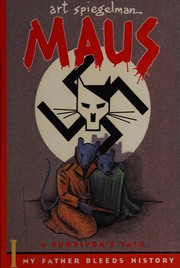
Read Maus I first, then Maus II. That is the whole reading order. The edition question has a short answer too: the two volumes were published separately in 1986 and 1991, they were later collected as The Complete Maus in a single book, and the contents are identical. Our list carries the two volumes. Buy one format or the other and not both, because the collected edition duplicates everything in the two-volume set.
The eleven years between the volumes are not incidental. Maus I ends with Vladek and Anja arriving at Auschwitz, and it was published while Spiegelman was still drawing the rest. In the interval the first volume became famous, and Maus II opens with Spiegelman drawing himself at his desk, paralysed by that success and by interviewers asking what colour mouse Israelis should be. That reaction is part of the second book. Reading them as one continuous volume flattens it, which is the argument for buying the two-volume set even though the one-volume edition is cheaper.
Check the language before you order
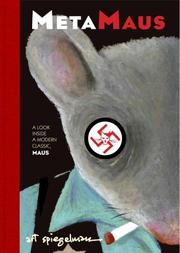
Two of the records here are not English editions. The record our catalogue matched for Maus I is a French printing, which is also why its page count looks like a combined edition rather than a single volume, and the record for MetaMaus is a German one. The titles display in English; the books are not.
Check the publisher and the listed language before ordering either. The other thing not to do is buy MetaMaus expecting the comic — it is a companion, not the work.
What the books are
Art Spiegelman interviewed his father, Vladek, a Polish Jew who survived Auschwitz, and drew the result — with Jews as mice, Germans as cats, Poles as pigs. The interviews themselves are in the book: the frame is Spiegelman in his father's apartment, badgering a difficult old man for his story and failing to get on with him. The two strands run together throughout, and the second is what makes it more than testimony.
Our records give the bare titles. They were published with subtitles — the first as My Father Bleeds History, the second as And Here My Troubles Began — under the series title A Survivor's Tale.
Content, as plain fact: the books depict the ghettos, hiding, betrayal and Auschwitz directly. Anja Spiegelman survived the camps and killed herself in 1968; her son found the body. That is drawn, in an earlier strip in a completely different style called Prisoner on the Hell Planet, which is reproduced inside the first volume and which also depicts Spiegelman's own psychiatric hospitalisation. Vladek burned Anja's diaries after her death, and the first volume ends with Spiegelman calling him a murderer for it. Depression, in both men, is on the page rather than behind it.
Maus received a Special Award from the Pulitzer board in 1992, and it has been the subject of school-board removals since, most publicly in Tennessee in 2022. Neither fact changes what is on the page, but both are why a lot of readers arrive here.
Read this next: the making-of
MetaMaus is Spiegelman's own book about Maus — a long interview with Hillary Chute, plus the transcripts of the tapes of Vladek talking, family photographs and documents, rejected pages and the sketches behind specific panels. It answers the questions readers actually have, including why mice. Read it after both volumes; it assumes complete familiarity and quotes freely.
Considering Maus is an academic essay collection edited by Deborah R. Geis. It is criticism written for scholars, not a general reader's companion, and it is useful if you want the arguments about representation, the animal metaphor and the ethics of the form set out properly.
Spiegelman's other comics
Breakdowns collects his early underground and formalist strips, reissued with a long autobiographical comics introduction. It is difficult, deliberately fragmentary work and it is not a follow-up to Maus — it is the experimental practice Maus came out of.
In the Shadow of No Towers is his response to 11 September 2001, drawn as oversized broadsheet pages and printed on board. It is closer to political cartooning than to memoir.
Comics by others, working the same ground
We Are On Our Own is Miriam Katin's memoir of escaping Budapest as a small child with her mother, drawn in soft pencil. I Was a Child of Holocaust Survivors is Bernice Eisenstein's account of growing up with the inheritance rather than the event — the closest thing here to Maus's second strand. The property, published as The Property, is Rutu Modan's fiction: a grandmother and granddaughter returning to Warsaw over a disputed apartment, and much funnier than that suggests.
Belonging is Nora Krug's investigation of her own German family's conduct under the Nazis, assembled from documents, flea-market photographs and painted pages. It is the perpetrator-side counterpart and the obvious book to read against Maus. Barefoot Gen Volume 1 is Keiji Nakazawa's autobiographical manga about Hiroshima, drawn in a cartoon style that makes what it shows harder rather than easier, and Palestine is Joe Sacco's reported comics from the occupied territories.
The critical frame
Disaster drawn, published as Disaster Drawn, is Hillary Chute's academic study of comics as documentary witness. It takes Spiegelman, Sacco, Nakazawa and Katin as its subjects, so it reads best last — it is the argument that connects everything above.
Where to stop
After MetaMaus, if you want one book more and nothing else. It closes the loop on the work itself. Everything after that is a different reading project.
Follow the full ordered path here: Maus Reading Order: Which Edition to Read and What to Read After It.