Most people meet proofs as a sudden cliff: calculus asked you to compute, and then a course simply demands that you justify. The vocabulary of quantifiers, contrapositives, and induction arrives all at once, and it is easy to feel that everyone else got a secret manual.
The fix is order. Start with a book that teaches the grammar of argument slowly, practice on friendly material where the stakes are low, and only then carry the skill into analysis and algebra, where proof is the whole game. Read this way and rigor becomes a habit rather than a hazing.
Build the proof habit
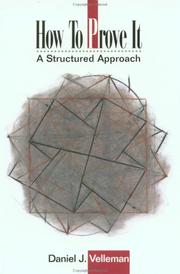
Begin with How to prove it, which treats logic and set notation as the raw material and walks through each proof technique with unusual patience. Book of Proof covers the same ground and is freely available, making it an ideal companion or alternative for self-learners. Mathematical Proofs : a Transition to Advanced Mathematics is the classic bridging text, with the exercises and worked examples that most courses assign. For a warmer, more conversational voice, Proofs: A Long-Form Mathematics Textbook explains not just how to write a proof but how mathematicians actually think their way to one.
Practice on real mathematics
Techniques stick only when you use them on genuine problems. Elementary number theory is the traditional proving ground: divisibility, congruences, and primes give endless clean statements to prove. Discrete Mathematics and Its Applications broadens the practice to combinatorics, graphs, and relations, the material that also underpins computer science. Alongside the technical work, How to solve it teaches the problem-solving heuristics — restating, specializing, looking for patterns — that keep you from staring at a blank page.
Carry proof into the core subjects
The real test is whether you can survive a rigorous course, and two are foundational. Understanding Analysis rebuilds calculus on airtight definitions, and its gentle, motivated style has rescued countless students from the shock of epsilon-delta. A Book of Abstract Algebra does the same for groups and rings, introducing abstraction through short, readable chapters. Finally, Proofs from the book is not a textbook but a celebration: a collection of especially elegant arguments that shows you what beautiful mathematics aspires to.
Work these in sequence and proof stops being a wall and becomes the language you think in. Follow the full path to go from your first careful argument to the rigorous courses that define a mathematics degree.
Follow the full reading path →
Ready to learn something deeply?
Build a reading path — free