Start with Memoirs of Hadrian. It is a single long letter from the ageing Roman emperor to the seventeen-year-old Marcus Aurelius, written in the knowledge that he is dying, and it does something historical fiction almost never manages: it thinks in the mind of its subject rather than dressing a modern consciousness in a toga. Yourcenar worked at it on and off for roughly thirty years, and the result reads as though it were dictated in one sitting.
The obvious alternative is to begin at the beginning with Alexis, or, The treatise of vain struggle, published in 1929 when she was twenty-six. It is a fine, cold little book, and it is apprentice work. There is no series here and nothing to spoil — her novels share a sensibility, not a world — so there is no argument for chronology, and every argument for reading the masterpiece first.
The composition notes are a second book
Our record for Memoirs of Hadrian bundles the novel with her reflections on writing it, and those notes are substantial enough to count as a short book in their own right: a record of decades of false starts, an abandoned draft burned, the discovery of the letter form, and the working method that produced the voice. They are among the best things ever written about how a historical novel gets made.
Read the novel first, straight through, without touching them. Then read the notes. Taken in the wrong order they will make you watch the machinery instead of the emperor.
The other major novel
The Abyss is the second essential book and the harder one. Zeno is a sixteenth-century physician, alchemist and free-thinker moving through a Europe of plague, inquisition and religious slaughter, and the novel follows him from restless youth to a cell. Where Memoirs of Hadrian is one serene retrospective voice, this is dense, fragmented and much less willing to console you. It is the book Yourcenar herself worked at longest after Hadrian, and readers who prefer it to Hadrian tend to prefer it strongly.
The early short fiction
Alexis, or, The treatise of vain struggle is a letter from a young musician to his wife, explaining why he is leaving her — a confession of homosexuality written in 1929 with enormous restraint and no self-pity. It is ninety pages and worth reading once you know the later work.
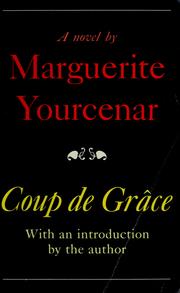
Coup de Grace is short, hard and the most uncomfortable thing in her catalogue: a Prussian officer in the Baltic civil wars of 1919 narrating his treatment of a woman who loves him. The narrator is reactionary, contemptuous and quite possibly lying about his own motives throughout, and Yourcenar's preface makes clear the book is an anatomy of him rather than an endorsement — readers still disagree about how successfully the novel holds him at a distance. Go in knowing that.
Fires is the outlier: not a novel but a sequence of lyrical prose pieces on Phaedra, Achilles, Antigone, Mary Magdalene and others, interleaved with aphorisms, written out of a personal crisis. It is the least like the rest of her and the most divisive.
Oriental tales is the best sampler she wrote — ten short stories drawn from Chinese, Japanese, Balkan and Greek sources, including the painter who walks into his own painting. If you want to test the prose before committing to The Abyss, use this.
The memoir
Dear Departed opens a three-volume family history, beginning with her mother's death days after her birth and reaching back through generations of Belgian relatives she never met. It is the first volume of a trilogy whose remaining parts are not in our catalogue, so be aware you are starting something you cannot finish here. It is also unlike the fiction — digressive, essayistic, genealogical — and belongs at the end of any reading of her.
Where to stop
Two books, and you have her: Memoirs of Hadrian and The Abyss. Everything else is a matter of appetite. Yourcenar became the first woman elected to the Académie française in 1980, and the case for that was made almost entirely by those two novels. Find more world-literature reading paths on Discover.
Follow the full ordered path here: Marguerite Yourcenar Reading Order: Where to Begin with Her Novels.