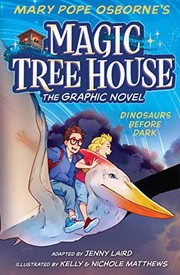
Start at Dinosaurs Before Dark, book one. Jack and Annie find a tree house full of books, discover that pointing at a picture takes them there, and the mechanics of the whole series are established in about forty pages.
The obvious alternative is to start with whichever topic a child already cares about — the Titanic book, the mummies book, the ninjas book. That mostly works, because each volume is a self-contained trip. But the books run in four-book arcs with a frame quest running underneath, and the first arc is the one that explains who sent the tree house and why. Starting at one costs nothing and answers the questions the later books assume you already have.
How the series is structured
Mary Pope Osborne wrote the fiction; Sal Murdocca illustrated it. Each book is a short chapter book built around one historical or natural-history setting, and every group of four shares a frame — a task set for Jack and Annie that runs across all four and resolves at the end. The first arc turns on the tree house's owner, Morgan le Fay.
That structure is why order matters more than the covers suggest, and also why it matters less than a strict series usually would: miss one and the next still works.
The gap in our list
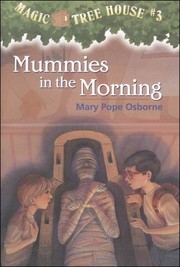
Our stage one covers books 1, 2, 3 and 5 — Dinosaurs Before Dark, The knight at dawn, Mummies in the Morning and Night of the Ninjas. Book 4, Pirates Past Noon, is not here. The record our catalogue matched under that title is the graphic-novel adaptation rather than the original chapter book, so it is not on the path.
It is in print and easy to buy; it simply is not in this list. If you are working through the first arc with a child, order it separately.
The rest of the sequence here
From book 5 the list runs continuously: Afternoon on the Amazon, Sunset of the Sabertooth, Midnight on the moon, Dolphins at Daybreak, Ghost Town at Sundown, Lions at Lunchtime, Polar bears past bedtime, Vacation Under the Volcano, Day of the Dragon King, Viking Ships at Sunrise, Hour of the Olympics and Tonight on the Titanic, which is book 17.
Books 18 to 28 are not in our catalogue. The list then jumps to Christmas in Camelot and Haunted castle on Hallows Eve, which are books 29 and 30.
The numbering change that confuses everyone
Christmas in Camelot is where the series changes shape. From that point the books are longer, the plots are continuous rather than episodic, and they were branded Merlin Missions. They were then renumbered: what is book 29 in the original sequence is Merlin Mission 1, book 30 is Merlin Mission 2, and so on.
So a shelf can carry two copies of the same story with different numbers on the spine, and a child asking for "number one" may mean either. Check the title, not the number.
The Fact Trackers
Knights and Castles is not a story. It is a non-fiction companion — originally sold as a Magic Tree House Research Guide, later rebranded Fact Tracker — pairing with The knight at dawn and covering real medieval castles, armour and siege warfare. Our record credits Will Osborne; the books are co-authored with Mary Pope Osborne.
They are optional. A child who finishes the knight book and immediately wants to know whether any of it was true is exactly who they are for.
Buying for a child
These are early chapter books, and the adult question is usually whether to buy singly, in the four-book arc sets, or in one of the large boxed collections. The arc sets are the sensible unit, because they match how the stories are built. Reading level and interest are separate questions and you are the one who knows the reader.
Browse the wider catalogue for what comes after these.
Follow the full ordered path here: Magic Tree House Reading Order: Where to Start.