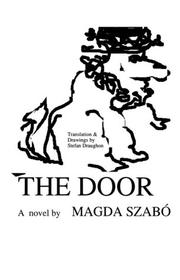
Start with The door. It is a two-hander between a writer and Emerence, the housekeeper she employs, and it is about the slow, mutual, catastrophic misreading of one person by another. It is the book that made Szabo's reputation in English, it is the one that is easiest to find, and it is the best-made thing she wrote.
The obvious alternative is Abigail, which is the most loved of her novels in Hungary and has sold enormously there. It is a boarding-school novel and it is wonderful. But it was written for younger readers, and an English-language reader who begins there tends to file Szabo as a writer of well-crafted school stories rather than as a novelist of complicity and betrayal under two successive regimes.
After The Door
Katalin Street is the next one. Three families on one Budapest street, a wartime catastrophe, and a narration in which the dead have as much presence as the living. It is short, structurally strange and unbearably sad, and it is the book that shows how much of Szabo is about the moment when ordinary people fail each other.
Iza's ballad follows a widowed provincial mother brought to Budapest by her successful, modern, entirely well-meaning daughter, who proceeds to erase her. Nothing cruel happens in it. That is what makes it hard. Our catalogue files this one under an inverted library form of her name rather than the form on the cover, which is a record quirk, not a different author.
Abigail belongs here, and by now you will read it correctly: a general's daughter hidden in a strict Protestant boarding school in wartime Hungary, who does not understand why until very late. It is a thriller with a schoolgirl narrator and it works completely for adults.
The fawn is the hardest of the group and should go last of the five. It is an early first-person novel narrated in a rush by a woman consumed by class resentment and by a hatred she has nursed since childhood, and the voice is deliberately unpleasant to be inside. Readers who love Szabo often name it; readers new to her often stop.
The harder-to-find books
Night of the pig-killing and Tell Sally.. are older English translations and are genuinely difficult to obtain — long out of print, and the second is recorded in our catalogue with a truncated title. If you want them, expect to look in second-hand listings or a library rather than a bookshop.
That points at a real gap, and the gap is ours. Szabo wrote for five decades — novels, plays, poetry, essays and a substantial body of work for children — and only a fraction has ever appeared in English. Several of her best-regarded Hungarian titles have no English edition at all, so this list is a translation history as much as a bibliography.
Two practical notes
Her recent English editions are largely the work of a small number of translators, with Len Rix responsible for the versions of The door, Katalin Street and Abigail that most readers will encounter. Translator quality varies more than usual here because the older editions and the newer ones came out decades apart.
There is no series and no continuity between the novels, so publication order carries no obligation — which is fortunate, because the English translations appeared in nothing resembling the order she wrote them. Order by accessibility instead, as above.
If you read three, read The door, Katalin Street and Abigail. That is Szabo the psychologist, Szabo the historian of a single street, and Szabo the storyteller. More translated-fiction sequences sit on Discover, and the Szabo hub collects the rest.
Follow the full ordered path here: Magda Szabo in Order: Where to Start with Hungary's Great Novelist.