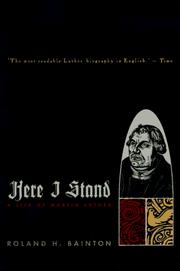
Start with Here I stand, Roland Bainton's 1950 biography, and then read Luther himself in The freedom of a Christian — about thirty pages from 1520 that contain the whole of his teaching on faith and works in a single paradox. Those two, together, are perhaps 370 pages and will give you more than any survey of the tradition.
Lutheranism is easier to read about than most confessional traditions because it has an unusually clear centre: one man's argument about how a person is made right with God, and one agreed book of documents defining what the church built on that argument holds. The order below works outward from both — the man, then his own prose, then the confessions and the theology, then five centuries of the church.
The man and the moment
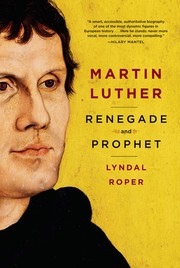
Here I stand has introduced Luther to more English readers than any other book, and it is still the best first read: vivid, fast, organised around the crises. The scholarship has moved on, and the later books are much easier once you have Bainton's narrative in your head. Martin Luther is Lyndal Roper's major modern life, by a historian of early-modern Germany who reads Luther psychologically. Luther is Heiko Oberman's argument that Luther makes no sense as an early modern man and only makes sense as a late medieval one living in expectation of the end — the most reorienting of the three. Brand Luther is Andrew Pettegree on the mechanism the theological books leave out: how the Wittenberg printing trade turned a university dispute into a mass movement.
The writings the tradition has had to answer for
Luther's late anti-Jewish tracts, above all On the Jews and Their Lies of 1543, are a matter of record. They are not on this list as texts — they are in neither the anthology nor the confessional documents — but the scholarship here does address them. Roper's biography treats them directly rather than as an appendix; Bainton, writing in 1950, moves past them faster. The tracts were later quoted by the Nazi state, and several Lutheran bodies have formally repudiated them, among them the Lutheran World Federation in 1984 and the Evangelical Lutheran Church in America in 1994. Whether the antisemitism is continuous with Luther's theology or separable from it remains a genuine scholarly disagreement, and none of these books settles it.
Luther in his own words
After The freedom of a Christian, the book to own is Martin Luther's Basic Theological Writings, the standard one-volume anthology edited by Timothy Lull and William Russell: the Ninety-Five Theses, the Heidelberg Disputation, the treatises on secular authority and the great 1520 pamphlets in one place. Work through it selectively rather than front to back. Martin Luther on the bondage of the will is his 1525 reply to Erasmus on free will, which Luther considered his most important book — long, ferocious, and the point at which justification is pushed to its hardest conclusion. Our catalogue holds it under that older title. The small catechism is a few dozen pages written for parents to teach children, and the text through which most Lutherans have actually met the tradition; read it immediately before the confessions, because it is their compressed form.
The confessions and the theology
The Book of Concord gathers the confessional documents in one volume: the Augsburg Confession and its Apology, the Smalcald Articles, both catechisms and the Formula of Concord. The Kolb and Wengert translation of 2000 is the current scholarly standard; the older Tappert edition of 1959 is also widely cited and is in our catalogue. The Theology of Martin Luther is Paul Althaus's classic systematic presentation, arranged by doctrine rather than chronology, which is exactly what you want after reading Luther in scattered treatises. Luther's Theology of the Cross is Alister McGrath's focused study of the single idea — that God is known in suffering and weakness rather than in glory — that most separates Luther from the scholastic tradition he came out of.
The church that followed
A History of Lutheranism is Eric Gritsch's standard one-volume history of the movement as an institution: confessional consolidation, Orthodoxy, Pietism, the Scandinavian state churches, the American synods. Lutheran theology is Steven Paulson's contemporary systematic theology, written from inside the tradition and deliberately combative, which makes it the liveliest way to see what is currently thought to be at stake; it assumes the Book of Concord. The cost of discipleship closes the path — Dietrich Bonhoeffer, a Lutheran pastor executed by the Nazi state, on cheap grace and what following Christ costs. It is the sharpest test the two-kingdoms doctrine has faced, made by someone who never left the tradition to make it.
Follow the full ordered path here: Lutheranism: What to Read, and in What Order.