Start with Walter Isaacson's Leonardo da Vinci (2017), a 599-page narrative biography built around the notebooks and organised as a case for curiosity as method. It is the most accessible complete life currently available and the right first book. Then put the notebooks in your hands, because every biography on this list is an argument about what is in them.
Before anything else, a cataloguing warning specific to this subject. Two different books here are filed under the bare title Leonardo da Vinci, and they are not remotely the same kind of book. Isaacson's is the 2017 narrative biography described above. Kenneth Clark's is a 194-page art-historical essay first published in 1939 — short, opinionated, concerned almost entirely with the paintings, and still quoted eighty years later. If you order by title alone you will get one when you wanted the other.
The notebooks
Leonardo finished perhaps fifteen paintings and left something over seven thousand surviving notebook pages, which is why the serious literature keeps insisting the notebooks matter more than the pictures.
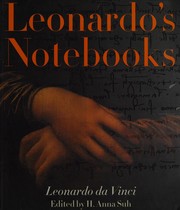
Leonardo's notebooks is a large-format selection edited by H. Anna Suh, pairing notebook text with the drawings it sits beside, and it is the best-illustrated way in. One caution: the edition our catalogue record points at is a Turkish-language printing, so check the language before ordering. The notebooks of Leonardo da Vinci is the standard fuller compilation, arranged by subject — anatomy, water, flight, painting, the aphorisms — and running well over a thousand pages. It is a reference you return to rather than a book you finish.
The scholarly lives
Charles Nicholl's Leonardo da Vinci: Flights of the Mind reconstructs the man from documents — tax records, court cases, shopping lists — rather than from the paintings, and it is the most vivid account of the Milan and Florence years.
Clark's Leonardo da Vinci established the modern art-historical account of the paintings and is the book to read for the pictures as pictures. It reflects the connoisseurship of its era, and several of its attributions and datings have been revised since, which is part of why it is worth reading alongside rather than instead of the others.
Leonardo da Vinci, the marvellous works of nature and man is Martin Kemp's standard scholarly treatment, arguing for a unified natural philosophy running through the anatomy, the engineering and the paintings. It is the most demanding book here and the one specialists cite.
One picture, one contemporary, two arguments
Leonardo and the Last Supper is Ross King on the commission, the failing experimental technique and the Milan politics surrounding a single mural — the clearest demonstration of how much context one picture carries. Lives of the Artists is Giorgio Vasari, first published in 1550 and the source of most of the anecdotes and much of the mythology, written by someone born after Leonardo had left Florence and who never met him. Read it here so you can separate the stories that are evidence from the stories that are Vasari. Note that our catalogue record for it is an audiobook edition of a selection.
Becoming Leonardo by Mike Lankford is a deliberately revisionist attempt to strip away the genius framing and read the documented behaviour instead; it is useful as a corrective after four admiring books, and it is a provocation rather than a scholarly consensus. How to Think Like Leonardo Da Vinci is a creativity workbook and not scholarship at all. It is included on that understanding, and it is the clearest example of the self-improvement afterlife that Lankford is reacting against. Read it last if at all.
Follow the full ordered path here: Best Books on Leonardo da Vinci, in Reading Order.
Ready to learn something deeply?
Build a reading path — free