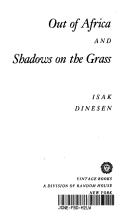
Start with Out of Africa. It is the most approachable prose she wrote, it carries the sentences people quote her for, and it is structured as a series of episodes rather than a continuous narrative, so it lets you leave and come back. The famous opening line does most of the work of telling you whether this writer is for you: if the cadence pleases you, everything else she wrote will reward the effort.
The obvious alternative is Seven Gothic tales, her 1934 debut and the book that made her name in America. It is the wrong first move. Those tales are dense, ironic, nested three deep, deliberately archaic in manner, and they assume a reader who already trusts the writer. Plenty of people have opened them cold and concluded she was unreadable.
A note on the name
She was Danish, born Karen Dinesen and married as Karen Blixen, and she published in English as Isak Dinesen — a male first name, chosen deliberately. Our records use both names, which is why the author line on these titles may not match the name at the top of this page. In Denmark she is Blixen; in the English-speaking world she is usually Dinesen; it is one person. She used a third name, Pierre Andrézel, for a gothic thriller not listed here.
The African books
Out of Africa is a memoir of the coffee farm she ran in the Ngong Hills from 1914 to 1931, written after she lost it. It is also, unavoidably, a settler's book: the farm sat on land taken from Kikuyu people, the labour was theirs, and Blixen writes about them with real affection organised inside an aristocratic and paternalistic frame she never questions. Readers differ sharply on whether the affection redeems the frame or is inseparable from it. Read it as both a great piece of English prose and a document of the thing it describes, and the book gets more interesting, not less.
Shadows on the Grass came nearly twenty-five years later and is a short coda — four sketches revisiting the same farm and the same people from old age, including news of what became of some of them. It is roughly eighty pages, it only works if you have read Out of Africa, and it is the natural second book.
The tales
This is the half of her career she cared most about, and it is where readers either commit or stop.
Winter's tales is the right place to enter. Written during the German occupation of Denmark and published in 1942, its stories are shorter, warmer and far more direct than her other collections, several of them set in the Denmark of her grandparents. If you are unsure whether you want the tales at all, read this one and decide.
Seven Gothic tales is the show of technique — stories inside stories, unreliable narrators, ruined castles, mistaken identities and a card-playing tone that keeps you at arm's length from every emotion. It is magnificent and it is work. Read it third, not first.
Babette's feast and other anecdotes of destiny contains the story most people have met on screen: a French cook, exiled among Danish puritans, spending a lottery windfall on one meal. The other pieces in the volume are strong too, and the whole thing is short.
Last Tales is late and uneven, with several pieces belonging to an unfinished novel. Read it only if the earlier collections have converted you.
Where to stop
Three books is a complete education here: Out of Africa, Winter's tales and Babette's feast and other anecdotes of destiny. That gets you the memoirist, the storyteller and the most famous single story. Everything else is for people who want more of the same voice — and if you want it, you will know by the end of the first. Browse more literary reading paths on Discover.
Follow the full ordered path here: Karen Blixen in Order: Where to Start with the Author Who Wrote as Isak Dinesen.