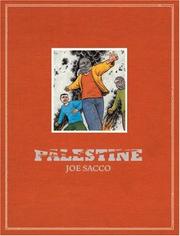
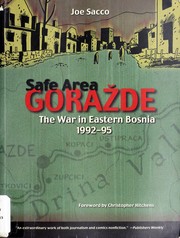
Start with Safe area Goražde — published as Safe Area Goražde — rather than with Palestine, which is the book most people name first. Both are Sacco doing the thing he invented, but the Bosnia book is where the method is finished: months of residence in a besieged enclave, named informants whose testimony is transcribed rather than paraphrased, and Sacco himself drawn into the panels as an obvious, awkward, note-taking outsider. Palestine was serialised in nine issues between 1993 and 1995 and reads like it — episodic, angrier, more interested in Sacco's own reactions than in constructing a case.
Read Palestine second, when you can see what he was still working out. That order costs you nothing: the books are unconnected, and nothing in the later work assumes the earlier.
What comics journalism actually is
Sacco reports the way a print journalist reports — he goes, he stays a long time, he interviews, he checks — and then draws the result. The drawing is not decoration. It lets him render what a photograph cannot get to: a killing described years later by three people who disagree, a room as a survivor remembers it, the same street in two different decades. His books carry endnotes, source lists and maps. They also carry a self-portrait that never quite gets its eyes drawn, which is the running joke and the running argument at once.
The Bosnia books
Safe area Goražde covers the eastern Bosnian enclave under siege between 1992 and 1995, built around the Muslim residents who stayed. The Fixer is the shorter, meaner follow-up: a portrait of Neven, the Sarajevo fixer who sold war stories to visiting journalists, and through him a piece about what foreign correspondents actually buy and from whom. It is the best short introduction to Sacco's ethics because he turns them on himself. War's end collects two shorter Sarajevo pieces and is the slightest of the three.
Palestine and Footnotes in Gaza
Palestine records two months in the West Bank and Gaza in the winter of 1991 to 1992, during the first intifada. Footnotes in Gaza is the far more ambitious book: a reconstruction of two 1956 killings in Khan Younis and Rafah that appear in the historical record as a footnote, assembled from contradictory eyewitness accounts nearly fifty years later. It is his longest and most demanding work, and the one where he most openly shows the reader how unstable memory-based reporting is. Sacco's sympathies in both books are with Palestinians and he does not pretend otherwise; critics have argued the advocacy compromises the reporting and others that the transparency is what makes it trustworthy. That argument is real and this guide does not settle it.
The later reportage
Paying the Land is a reported book about the Dene of Canada's Northwest Territories, resource extraction, residential schools and the fights inside Indigenous communities over what development is worth. It is the most patient thing he has done. Journalism is a collection of shorter magazine assignments — Chechen refugees, Iraqi detainees, African migrants at Malta, an Indian caste case — and works as a sampler if you want to know whether the form suits you before committing to a long book. The Great War July 1 1916 is not a comic at all: it is a single wordless panorama of the first day of the Somme, printed as a folding panel over seven metres long. Know that before you buy it.
The early work and the collaboration
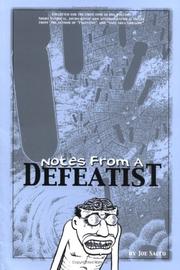
Notes from a Defeatist gathers his pre-Palestine short comics, including satire and autobiography alongside the first reported pieces. Read it last; it is interesting mainly as evidence of where the reporting came from. Days of destruction, days of revolt is a collaboration with the journalist Chris Hedges — Hedges wrote the prose reporting on four American sacrifice zones and Sacco drew the comics sequences inside it. Our catalogue record credits Hedges alone, which understates Sacco's role but correctly signals that this is a Hedges book with Sacco in it, not a Sacco book.
Honest warnings
These books describe and depict massacre, torture, rape and the aftermath of shelling, drawn in detail. Sacco does not use distance as mercy. If that is not what you want, the closest thing to an easy entry is Journalism, where the pieces are short enough to put down. More reported non-fiction lives on Discover.
Follow the full ordered path here: Joe Sacco Reading Order: Where to Start With Comics Journalism.