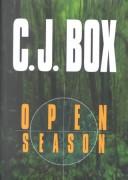
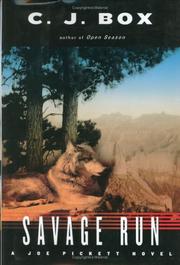
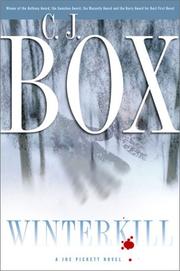
Start with Open season. Publication order and chronological order are the same thing across the series, and unlike most procedurals this one genuinely punishes jumping in. Joe's daughters age in real time, Nate Romanowski arrives in the second book and becomes the series' second lead, and a storyline that begins in Winterkill does not resolve for another five novels. Read out of sequence and the largest emotional turn in twenty-odd books lands as a footnote.
The obvious alternative — start with whichever book a friend or an adaptation pointed you at — costs more here than it usually would. It also gains nothing, because Open season is a good novel on its own terms: a Wyoming game warden, badly paid and routinely outmatched, investigating three dead outfitters and an endangered species in a town that depends on a single employer. Joe's habit of losing hold of his weapon is a running joke and a deliberate corrective to the competent-hero convention.
The first six
Open season (2001) establishes the family, the county and the job. Savage run (2002) opens with an exploding cow and introduces Nate, a falconer with an unexplained special-operations past. Winterkill (2003) is a federal land dispute that becomes a standoff, and it brings April into the family. Trophy hunt (2004) is the series' one venture toward the uncanny, resolved conventionally. Out of range (2005) seconds Joe to Jackson Hole and is the most domestic entry, largely about the marriage. In plain sight (2006) turns on a family feud and has one of the best villains.
These six form a coherent arc. If you want a finite reading experience rather than an open-ended commitment, stop here.
The middle run, and where it sags
Free Fire (2007) is built on a real jurisdictional gap in Yellowstone, and the book is more interested in the gimmick than in Joe. Below zero (2009) is where the April storyline returns; do not read it early. Nowhere to run (2010) puts Joe alone in the mountains and is a deliberate return to the small scale. Cold Wind (2011) takes on wind turbines and Joe's mother-in-law and is among the best of the second decade. Force of nature (2012) is effectively Nate's book, filling in his background and his pursuers.
The honest warning: the stretch from Free Fire through Force of nature leans hardest on conspiracies, federal antagonists and Nate's near-mythic vigilante register. Readers who came for a small-scale Wyoming procedural often find this run thinner, and it is the most common place people stop. It tightens again afterwards.
The books are also consistently sceptical of federal agencies and national environmental organisations and sympathetic to rural Westerners. That is a stance rather than a neutral backdrop, and it is worth knowing you are reading it.
The later books
Endangered (2015) returns to April and is among the strongest late entries. Vicious Circle (2017) and The disappeared (2018) continue the running feud with the Cates family, which by this point is the series' main antagonist thread.
This list is not complete, and the gaps matter for a series this continuous. Blood Trail sits between Free Fire and Below zero; Breaking Point and Stone Cold sit between Force of nature and Endangered; Off the Grid sits before Vicious Circle. The series continues well past The disappeared with Wolf Pack, Long Range, Dark Sky, Shadows Reel, Storm Watch and Three-Inch Teeth. None of those are in our catalogue. Read the order above as the spine, not the full shelf. More series orders are on Discover.
Follow the full ordered path here: Joe Pickett Reading Order: Where to Start with C.J. Box.
Ready to learn something deeply?
Build a reading path — free