Start with Shogun. The six Asian Saga novels span three and a half centuries and were written in roughly the reverse of that order, which is why every new reader asks which sequence to use — and the answer is publication order with one deliberate exception, which is to open with the third book.
Shogun is the first chronologically, it is by a wide margin the strongest of the six, and it is the only one that will settle for you whether you want the other five. An English pilot is wrecked on the coast of Japan in 1600 and drawn into the succession struggle that produced the Tokugawa shogunate. It needs no other book to work, and if it does not hold you, nothing later will.
The two orders, and which to use
Internal chronology runs Shogun (1600), Tai-Pan (1841), Gai-Jin (1862), King Rat (1945), Noble House (1963) and Whirlwind (1979). Publication order runs King Rat, Tai-Pan, Shogun, Noble House, Whirlwind, Gai-Jin.
Neither is right on its own. What matters is that four of the six share a family — the Struans and the Brocks — and those four do reward being read in internal order, because half the pleasure of the 1963 book is watching grudges from 1841 still running. So: Shogun first, King Rat second because it is short and stands alone, then the Struan sequence in date order, then the last of the saga.
King Rat, and what the saga is made of
King Rat is the debut and the shortest and hardest book here: a Japanese prisoner-of-war camp in Singapore, where an American corporal thrives by trading. Clavell spent three years in Changi as a prisoner, and this is the autobiographical root of every later novel's interest in survival and in the outsider who learns the local rules. Read it second, while the method of Shogun is fresh.
That biography is also the reason for a caveat worth stating before you commit a few thousand pages. These are novels of cultural collision written from one side of it, and the Asian Saga — Shogun in particular — has been criticised, including by scholars of Japan, for how it renders Japanese characters and history through a Western protagonist's eyes. Other readers regard it as unusually sympathetic for its moment. Both positions are held seriously; this page does not settle them, but the books are more interesting if you know the argument exists.
The Struan century
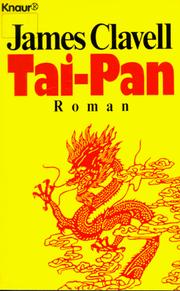
Tai-Pan (Asian Saga — the catalogue record is truncated mid-parenthesis; it is the 1966 novel — puts Hong Kong in 1841, founded on the opium trade by Dirk Struan of the Noble House. It is the origin of the family thread and the book you must read before the 1963 one.
Gai-Jin (Asian Saga, also truncated in the records, is Yokohama in 1862, with the Struan heir among foreigners in a Japan violently unwilling to have them. It was the last novel Clavell published and is the weakest of the saga — slower, and repetitive — but it fills the gap in the family story.
Noble House is Hong Kong in 1963: a thousand pages covering about a week, a corporate takeover fight crossed with espionage, bank runs and a hillside collapse. It is the most purely enjoyable of the six, and far better with the 1841 novel fresh.
The last of the saga
Whirlwind, Volume One is Iran during the 1979 revolution, following a helicopter company trying to get its aircraft and crews out. It is the longest and most sprawling of the six and the one most readers abandon. Note the record here is volume one of a two-volume paperback split, not a separate novel, and that Clavell later cut one storyline out and republished it as Escape, which is not new material.
The children's story is a short parable — a new teacher reshapes a classroom of American children in twenty-five minutes — and reads in one sitting. Nothing like the novels, but the clearest statement of what Clavell thought about institutions and obedience.
The history underneath
Shogun : The Life and Times of Tokugawa Ieyasu is the standard English life of the warlord fictionalised as Toranaga, and reading it shows where Clavell followed the record and where he compressed decades into months. Samurai William covers the real English pilot who became a samurai. The Opium War retells the war that made Hong Kong using Chinese sources Clavell's generation did not draw on, and the Struan fortune reads differently afterwards. Hong Kong is Jan Morris on the colony across the whole period the saga brackets. Prisoners of the Japanese is the documented history of Allied prisoners in the Pacific war, Changi included, and it is harsher and less romantic than King Rat — the most useful corrective on this list.
Follow the full ordered path here: James Clavell Asian Saga books in order: where to start.