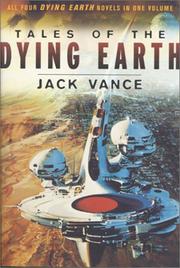
Start with Tales of the Dying Earth, and once inside it go to the Cugel material rather than page one. Vance wrote for sixty years across a dozen loosely connected settings, and reading him chronologically is a mistake: the entry point is a matter of picking the right short book, not of starting at the beginning.
Cugel is the reason. He is a thief of surpassing self-regard who is repeatedly outwitted by people even worse than he is, and the two Cugel books are the funniest thing Vance wrote and the purest sample of what people read him for — an ornate, ironic, faintly archaic voice that Gene Wolfe, Dan Simmons, George R. R. Martin and a good many of the original designers of Dungeons and Dragons all took something from. You will know inside a hundred pages whether that voice is for you.
An edition warning that shapes the first stage
Tales of the Dying Earth is an omnibus. It collects all four Dying Earth books — the 1950 story collection, The Eyes of the Overworld, Cugel's Saga and Rhialto the Marvellous — and the individual volumes resolve unreliably in our catalogue, which is why this list uses the omnibus rather than mixing the two. Do not buy both: you will own the same stories twice.
The same trap appears at the other end of this list. Lyonesse: Suldrun's Garden exists in our catalogue under a second record as well, filed without the series prefix. Buy one, not both.
The two great novellas
The Dragon Masters runs about a hundred pages, won a Hugo, and is the best short sample of Vance in a serious register: two feuding human clans on a remote planet, each breeding the other side's captured soldiers into livestock. The last castle is the companion piece, shorter and also a Hugo winner, in which a decadent human aristocracy discovers that its servant species has stopped serving. The two are frequently printed together and make a two-hour case for the writer.
The standalone novels
Emphyrio is the one most Vance readers name as his best novel — a boy on a rigidly guild-bound planet uncovers what his world's founding myth was actually about. It is slower and sadder than the adventure books. The Languages of Pao deliberately re-engineers a society by imposing new languages on segments of its population to make them warlike, mercantile or technical; written in 1958, it is the purest expression of Vance's real subject, societies as machines with rules. Big Planet (Ace SF, G-661) is an enormous low-gravity world of hundreds of incompatible human cultures crossed on foot by a stranded expedition, essentially a picaresque tour of invented societies. Its catalogue record carries an old paperback series code in the title; it is the 1957 novel.
The Demon Princes, in order
Read these five straight through. Kirth Gersen's family and village were destroyed by five criminals, and he kills one per book. The Star King announces that structure immediately, so the interest lies entirely in how, and in whose strange worlds he has to go to do it. The Killing Machine shows the formula is a licence rather than a limit, the hunt being largely a pretext for touring a very odd planet. The Palace of Love is the strangest of the five, built around a poet-tyrant's constructed paradise. The face (The complete works of Jack Vance) is book four — the catalogue has appended a collected-works series note to its title — written a decade after the third with a noticeably drier style. The book of dreams closes the sequence on what a life organised entirely around revenge is supposed to become afterwards, and it only lands if the earlier four are fresh, so read the run over weeks rather than years.
Lyonesse
Late Vance at his most expansive, and the sequence many readers consider his real masterpiece. Lyonesse: Suldrun's Garden is set on an invented archipelago off pre-Arthurian Europe and mixes fairy tale, dynastic politics and considerable cruelty. Lyonesse: The Green Pearl widens the canvas; it is the weakest of the three read alone and the necessary one read in sequence, so do not skip it. Madouc concludes the trilogy, won the World Fantasy Award, and is the warmest thing Vance ever wrote — the right book to finish on. If you want more after it, the Alastor and Cadwal sequences are where to go next.
Follow the full ordered path here: Jack Vance books in order: where to start with the Dying Earth.