Start with Franny Moyle's biography, published as Turner: The Extraordinary Life and Momentous Times of J. M. W. Turner and filed in our catalogue under the bare surname Turner. It is the best modern life: strong on the Covent Garden barber's shop he came from, on the money, on the concealed domestic arrangements, and on the professional knife-fighting inside the Royal Academy. Read it before anything about the paintings, because almost every specialist volume on Turner takes the outline of the life as given — and that life was deliberately obscure even to the people who knew him.
A practical warning first, because it costs money. An unusual number of books on Turner are catalogued under a bare display title, sometimes just the surname, so several records here look nearly identical on a shelf listing. Check the author and the subtitle rather than the spine when you order, and note that James Hamilton wrote two separate Turner books. Each entry below names its author and what kind of book it is.
The life
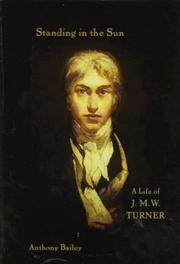
After Moyle, read Anthony Bailey's Standing in the Sun, the other major biography and a warmer one. Bailey is better on the travelling, on Turner's relationships with his patrons, and on the texture of ordinary days; treat it as the complementary portrait rather than a rival account. James Hamilton's biography, catalogued as Turner - a Life and published as Turner: A Life, earns its place for one thing the others handle thinly — Turner's engagement with the science of his day, meteorology and colour theory and the machinery of the new industrial landscape.
The pictures
Andrew Wilton's Turner and the sublime is an exhibition study, and it is the book that turns admiring the late canvases into understanding them: how Turner used the eighteenth-century category of the sublime and then took it apart. Wilton ran the Turner collection at the Tate, which is why the picture-by-picture argument carries.
Sam Smiles's critical survey, catalogued under the bare title J.M.W. Turner, comes next. It is compact, covers the whole output rather than the life, and is the clearest guide to what Turner scholars actually argue about — finish versus non-finish, the status of the oil sketches, how modern the late work really is. Then Judy Egerton's Turner, the fighting Temeraire, a monograph on a single painting: what the ship was, what the scene could and could not have looked like, what Turner changed. Most readers find the single-work monograph the most instructive form in art history, and this is a model of it.
Turner among rivals, critics and champions
Wilton's second book here, Turner in his time, is a documentary life assembled from reviews, letters, diaries and sale records — useful precisely because it shows how much of the work baffled contemporaries. David Solkin's Turner and the masters is the catalogue of the exhibition that hung Turner beside Claude, Poussin, Rembrandt and Canaletto, and it reframes the career as a sustained campaign to beat the old masters at their own subjects.
Ian Warrell edited the Tate's Venice exhibition volume, published as Turner and Venice; our catalogue record for it carries a marketplace string, TURNER AND VENICE; ED. BY IAN WARRELL. It covers the work where the watercolours and late oils come nearest to abandoning subject altogether. Finally John Ruskin's Modern painters, begun in his early twenties as a defence of Turner against hostile critics and grown into five volumes of Victorian art theory. Read the first volume only, and read it as advocacy: it created Turner's reputation, and it is not a reliable guide to the man.
The Bequest and the reference shelf
Turner left roughly thirty thousand works on paper to the nation, and two books open that material. Warrell's Turner's sketchbooks is a guide to the notebooks he carried on every journey — nothing else shows so plainly how constantly he drew. The Oxford companion to J.M.W. Turner, compiled by Martin Butlin, Luke Herrmann and Evelyn Joll, is a reference work with entries on individual pictures, patrons and places; keep it beside you rather than reading it through.
Last, Walter Thornbury's The life of J.M.W. Turner, R.A from 1862, written from interviews with people who had known him. It is the source of most surviving anecdotes and it is also gossipy, unreliable and resented by serious scholars ever since — which is why it belongs at the end, once you can read it critically.
Work through the stages in order and the late pictures stop looking like a mystery.
Follow the full ordered path here: The Best Books on J. M. W. Turner, in Reading Order.