Start with Isaac Newton by James Gleick. It is about two hundred pages, unusually well written, and it gives you the shape of the life without demanding that you follow the mathematics. If you would rather have a specialist compress it, Newton by Rob Iliffe is the Oxford Very Short Introduction and is considerably better on the theology and the manuscript evidence.
What makes this subject strange is that there are effectively two Newtons in print. One wrote the Principia and Opticks and invented the calculus. The other spent decades on alchemical experiment and on anti-Trinitarian biblical chronology, and left more words on those than on physics. Popular accounts before the 1970s quietly dropped the second; once the Portsmouth and Keynes manuscript collections were properly studied, that stopped being possible. How the two connect is genuinely disputed — Betty Jo Teeter Dobbs argued the alchemical work fed directly into the physics, Richard Westfall gave the alchemy serious weight without going that far, and other historians treat the pursuits as largely separate compartments in one very odd mind. Do not take whichever book you read first as the settled account.
Short lives
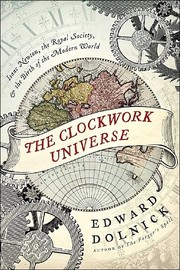
Gleick's Isaac Newton and Iliffe's Newton are the two efficient entries, and they complement rather than duplicate each other. The clockwork universe by Edward Dolnick is popular history of the Royal Society generation — entertaining, and more about the age than about Newton; if you have read Gleick you can skip it without losing much.
The full-length biography
Never at rest by Richard S. Westfall is the standard scholarly life, published in 1980 and running to some nine hundred pages. It works through the science in real detail and asks for patience rather than a physics degree, and it has not been superseded. In the presence of the Creator by Gale E. Christianson is the other full-length biography from the same period — more readable, lighter on the technical material, and a legitimate substitute if Westfall is more than you want. If you are going to read one long biography, read Westfall.
The science itself
The Cambridge Companion to Newton, edited by I. Bernard Cohen and George E. Smith, is a collection of specialist essays on the mathematics, mechanics, optics, alchemy and theology. It is the efficient way into current scholarship and you can take single chapters. The Newtonian revolution, Cohen alone, is a monograph on Newton's method — how he moved between an idealised mathematical model and the physical world, which is the actually novel thing he did.
Then the sources. The Principia in the Cohen and Anne Whitman translation, with Cohen's long introductory guide, is the book itself. Be warned that it is written in classical geometry rather than in the calculus Newton had available, which is why it is difficult even for readers with a physics background. Opticks is the far more approachable primary source: written in English, organised around experiments, and meant to be followed. Read it before attempting the Principia. Newton's Principia for the common reader by Subrahmanyan Chandrasekhar reworks the propositions in modern terms — the title is a joke, it wants calculus and stamina, but it is the honest bridge for someone who genuinely wants the arguments rather than an account of them.
The other Newton
The Janus Faces of Genius by Betty Jo Teeter Dobbs is the scholarly case for the alchemy mattering to the physics, and is the contested thesis described above rather than a neutral survey. Priest of nature by Rob Iliffe is on the religion: Newton denied the Trinity, which for the holder of a Cambridge fellowship was serious heresy he concealed for life, and he wrote at enormous length on prophecy and chronology.
Newton and the counterfeiter by Thomas Levenson covers his years running the Royal Mint and his pursuit of the coiner William Chaloner to the gallows — narrative history, a genuinely good read, and the least mathematical way into the man. The Calculus Wars by Jason Socrates Bardi tells the priority quarrel with Leibniz. The modern historical view is that the two invented the calculus independently and that Leibniz's notation is the one we use; Newton's own conduct, including anonymously writing the Royal Society report that adjudicated his own claim, is not defensible and Bardi does not defend it.
The full path keeps this order — biography, then science, then the parts the Victorians left out.
Follow the full ordered path here: Isaac Newton: The Best Books About Him, in Reading Order.