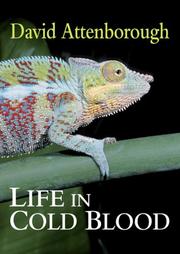
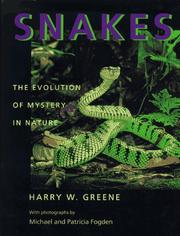
Start with David Attenborough's Life in Cold Blood, the companion volume to his series, which is the most efficient survey available: thermoregulation, parental care, venom and courtship shown through specific animals rather than defined in the abstract. Then read Harry Greene's Snakes before you open a textbook. The two standard texts are much easier once you already have animals in your head.
One practical warning before the list, because this subject has a cataloguing problem. Two different university textbooks are titled simply Herpetology, and several of the best books here are filed under bare one-word titles — Snakes, Frogs, Lizards. Author names are the only reliable way to order the right book, so this guide names authors throughout.
Start with the animals
Life in Cold Blood gives you the whole clade in one sitting. Harry Greene's Snakes, the 1997 University of California Press book published as Snakes: The Evolution of Mystery in Nature, is genuinely literature as well as science; Greene builds snake evolution, feeding and defence out of decades of his own fieldwork. Mike Dorcas and Whit Gibbons's Frogs answers the questions people actually ask about frogs, which turns out to be a good route into amphibian biology, and it matters that the amphibians are as vivid to you as the reptiles before a textbook treats them as parallel chapters.
Learn to identify what is in front of you
Roger Conant and Joseph Collins's A field guide to reptiles and amphibians of eastern and central North America is the Peterson guide that trained several generations of American herpetologists. Work through the keys rather than only the plates: reading a diagnostic character is the transferable skill, and every later chapter silently assumes it. Robert Stebbins's A field guide to western reptiles and amphibians is the standard for the other half of the continent, and paired with Conant it also shows how two authors solve the same problem of making a key usable in the field. Franck Bonin and colleagues' Turtles of the world is the accessible global account of a group most general herpetology reading short-changes, family by family with conservation status.
The two standard textbooks
F. Harvey Pough and colleagues wrote one Herpetology; George Zug, Laurie Vitt and Janalee Caldwell wrote the other. They are different books despite the identical spine. Pough is the more ecologically and physiologically weighted of the two and its chapter order runs closer to the way the narrative books think, so read it first. Zug, Vitt and Caldwell is stronger on systematics and phylogeny and is the better one to keep as a reference. William Duellman and Linda Trueb's Biology of amphibians is the amphibian reference the textbooks compress; use it when a chapter on caecilians or larval ecology leaves you wanting more, not as a cover-to-cover read.
The specialist problems
Christie Wilcox's Venomous is the clearest popular account of what venom is chemically and how it evolved independently many times, which is exactly where textbook coverage is thinnest. Eric Pianka and Laurie Vitt's Lizards uses one group as the model system for general questions about diversity, niche and community ecology, and is the best demonstration in the field of that approach. Michael Lannoo's Amphibian declines is the large edited conservation-status volume on the amphibians of the United States and the reference behind the phrase global amphibian decline; it is a compendium, so read the framing chapters and then the accounts for species near you.
The working life
Harry Greene's Tracks and Shadows is his memoir of field biology as art, written after the snake book and far more personal — read it once you know his science. Eli Greenbaum's Emerald Labyrinth is a herpetologist's account of survey expeditions in the Democratic Republic of Congo, covering the logistics, the militias and the new species, and it is an honest closing picture of what documenting reptile diversity involves today.
None of these are pet-keeping books, and none of them are guides to handling venomous animals; fieldwork with reptiles and amphibians involves permits, training and real risk, and that is not something a reading list substitutes for. The full ordered path with stage goals is below, and more natural-history subjects are on Discover.
Follow the full ordered path here: Best Books on Herpetology: Reptiles and Amphibians, in Order.
Ready to learn something deeply?
Build a reading path — free