Haskell has a steep reputation, but the steepness is mostly about unlearning habits from imperative languages: no loops, no mutable state by default, and a type system that does far more than catch typos. The common failure is reaching for a monad tutorial in week one, before you have any feel for the language's basic shape.
The order that works is patient. Get fluent in pure functions and pattern matching first, then build real programs, and only then tackle the abstractions — monads, typeclasses, effects — that the language is famous for. Approached this way, the concepts that intimidate people arrive as answers to problems you have already met.
Ease in
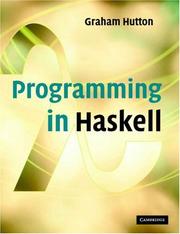
Start with Programming in Haskell, a concise and carefully paced introduction from a respected teacher that builds the language cleanly from the ground up. Learn You a Haskell for Great Good! is the famously friendly, illustrated companion that makes the early ideas approachable and fun. For readers who want a single thorough on-ramp, Haskell Programming from First Principles is exhaustive and exercise-heavy, taking a complete beginner all the way to competence without hand-waving.
Build real things
Once the basics stick, shift to writing programs. The Haskell School of Expression teaches functional thinking through graphics and multimedia, which keeps the abstractions grounded in visible results. Real World Haskell is the classic on using the language for practical tasks — parsing, I/O, databases — and shows that Haskell is a working tool, not just a teaching language. Effective Haskell is the modern counterpart, focused on writing idiomatic, maintainable code the way experienced Haskellers actually do.
Into the type system
The last arc is where Haskell's power concentrates. Thinking with Types introduces type-level programming, making the compiler enforce properties most languages can only hope for at runtime. Algebra-Driven Design then shows how to design software by starting from algebraic laws and deriving the implementation, a way of working that Haskell enables uniquely well. These are advanced, but by this point you will have the footing to appreciate them.
Read in this order and Haskell stops feeling like a puzzle and starts feeling like a sharper way to think about programs. Follow the full path to go from your first pure function to type-level design.
Follow the full reading path →
Ready to learn something deeply?
Build a reading path — free