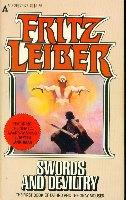
Start with Swords and Deviltry. It is the first of the seven Lankhmar volumes in Leiber's own sequence, and it collects the origin stories plus Ill Met in Lankhmar, the Hugo and Nebula winner in which Fafhrd and the Gray Mouser meet and immediately lose everything.
That recommendation contains the one real order controversy here, so take it head on. Leiber coined the phrase sword and sorcery, wrote these characters for nearly fifty years, and then late in life reorganised the whole run into seven books that put the internal chronology first. The origin stories in volume one were written last. Publication order and reading order are therefore genuinely different, and the case for publication order is that you watch a writer find his voice in real time.
Use Leiber's order anyway. He built it deliberately, the volumes are packaged and sold that way, and the origin material is strong enough to open with — Ill Met in Lankhmar is the single best thing in the sequence and putting it first is not a mistake. The cost is real but small: you meet the polished late Leiber before the rougher early one.
The seven volumes, in Leiber's sequence
Swords and Deviltry, Swords Against Death, Swords in the Mist, Swords Against Wizardry, The swords of Lankhmar, Swords and Ice Magic, The knight and knave of swords.
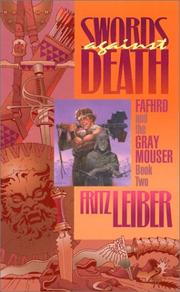
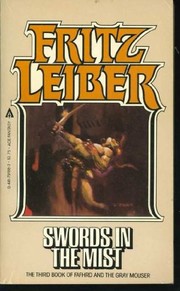
Swords Against Death is the real beginning of the series as originally published — ten stories of wandering, grief and mercenary work, and where the Lankhmar of legend actually gets built. Swords in the Mist shows how strange the run is willing to get, including a detour to our own Earth. Swords Against Wizardry holds the mountaineering novella Stardock and the Quarmall sequence, and is the closest the series comes to conventional adventure.
A buying warning before you start
A separate collection also titled Ill Met in Lankhmar reprints the first two volumes together in one book. Buy that or buy the two, not both — a lot of readers end up owning the same stories twice.
The novel, and where to stop
The swords of Lankhmar is the only full-length novel in the sequence and the fifth volume in order: an infestation of intelligent rats beneath the city, at full comic and erotic strength. Most readers rate it the high point, and it is openly bawdy in a way the earlier collections only imply.
Swords and Ice Magic was written when Leiber was in his sixties and is audibly a book about ageing — slower heroes, an elegiac tone, and the Death of Nehwon taking an interest in them. It is uneven and it is moving in a way the early volumes never attempt. The knight and knave of swords, from 1988, is the seventh and last, and by most accounts the weakest. Stopping after the sixth volume is a perfectly reasonable place to leave the series; read the seventh for completeness rather than for pleasure.
The science fiction
This is a second career, not an appendix, and it won him a Hugo before Lankhmar was collected at all. The Big Time is the best entry point outside Lankhmar: a time war told entirely in one room, in real time, as a stage play, and short enough to read in an evening — which is how it should be read. Our catalogue also carries it bound with the collection The Mind Spider, so look for the standalone edition if you want only the novel.
The Wanderer took the Hugo in 1965: a planet appears beside the Moon and a dozen scattered viewpoints follow the consequences, a disaster novel written as a mosaic. A specter is haunting Texas is broad satire and the funniest of the novels, with a space-born actor in an exoskeleton arriving in a post-nuclear Texas that has annexed most of the continent. The green millennium, about a green cat loose in a corrupt near-future Los Angeles, is minor.
The horror, which may be the best of him
Conjure Wife is the founding text of domestic supernatural horror: a sociology professor discovers his wife practises magic, and so does every other faculty wife, with the whole campus career ladder running on charms. It has been filmed three times. Our Lady of Darkness is his last major work and, by common agreement, his best — a widowed writer in San Francisco, drinking too much, discovers a theory that cities generate their own malign entities. It draws closely on Leiber's own life after his wife's death and keeps no distance from it. Night's Black Agents, the 1947 Arkham House collection, contains Smoke Ghost, the story that dragged the ghost story out of the country house and into the industrial city. Read it last as the origin point of the other two.
More on the Fritz Leiber hub.
Follow the full ordered path here: Fritz Leiber books in order: where to start with Fafhrd and the Gray Mouser.