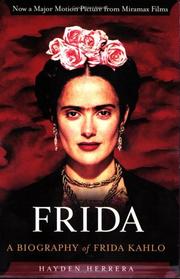
Begin with Hayden Herrera's biography. It is over forty years old, later scholarship has corrected details, and it remains the book that organises everything else: it established the chronology, located the paintings within it, and is the source most subsequent writing argues with.
One warning first, because our catalogue creates it. Herrera's biography appears on this path twice, once as Frida and once as Frida, a biography of Frida Kahlo. These are the same book under two title forms. Buy one.
The life
Frida is the full biography — long, detailed, strongest on the Mexico City art world and the marriage. Andrea Kettenmann's Frida Kahlo is the short illustrated introduction from the Taschen series: inexpensive, well reproduced, and the right book if you want the paintings in front of you while you read Herrera.
Kahlo's work cannot be separated from her body, and that is a fact about the paintings rather than a framing device. She had polio as a child and a bus accident at eighteen drove a handrail through her pelvis. She underwent roughly thirty operations over the rest of her life, spent long periods in plaster corsets and in traction, had her right leg amputated below the knee in 1953, and died the following year at forty-seven. Surgery, miscarriage, casts, spinal columns and open wounds are the literal content of a large share of her self-portraits. Any book that treats the illness as biographical colour rather than as subject matter is misreading the work.
Her own words, with the usual caution
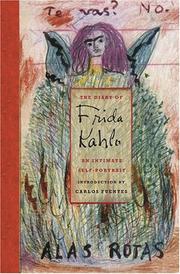
The diary of Frida Kahlo is a facsimile of the notebook she kept in her last decade, reproduced in full colour with a transcription and commentary — drawings, colour experiments and text that runs between private code and love letter. The letters of Frida Kahlo and Frida by Frida are two selections of correspondence, the latter a larger gathering assembled by Raquel Tibol, who knew her. Read all three as performance as well as evidence: Kahlo wrote for particular readers, and the diary in particular is a working document rather than a confession.
The paintings
Luis-Martin Lozano's The Complete Paintings is the large-format survey of the entire painted output with scholarly apparatus — the reference volume, and the one to consult when a book mentions a painting you cannot picture. Adrian Locke's Frida Kahlo is an illustrated survey in the exhibition-catalogue mould, lighter and more portable.
Diego, the house, the kitchen
Frida Kahlo and Diego Rivera by Isabel Alcantara is a short dual portrait of the marriage. Patrick Marnham's Dreaming with his eyes open is a full biography of Rivera and a genuinely useful counterweight, since Rivera was a prolific fabulist about his own life and much of the Kahlo legend passed through him first. Frida Kahlo at home by Suzanne Barbezat is a place-led book — the Casa Azul, Coyoacan, the objects and the garden. Frida's Fiestas was written by Guadalupe Rivera Marin, Diego's daughter, and mixes recipes with recollection; it is a participant's memoir, warm and unverifiable, not scholarship.
The counterweight
End with Margaret Lindauer's Devouring Frida, an academic critique of exactly the reading habit the rest of this list encourages: the tendency to treat every painting as an illustrated episode from the biography, and the commercial machinery that grew around the image. It argues against the method most of these books use, which is precisely why it belongs last rather than first.
Work through the path in that sequence — life, voice, paintings, marriage, critique — and you end up able to look at the pictures as pictures.
Follow the full ordered path here: How to Read About Frida Kahlo: The Best Books, in Order.