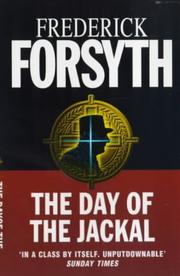
Start with The Day of the Jackal. It was his first novel, it invented the form he then worked in for fifty years, and nothing he wrote afterwards improves on it. An assassin is hired to kill de Gaulle, a president who demonstrably was not killed, and the suspense survives that fact entirely because the interest is in method rather than outcome.
There is no series to follow. Forsyth's novels are standalones with no recurring characters, so the only useful order is quality, and quality declines fairly steadily after about 1984. What follows is the sequence worth reading, and the point at which to stop.
The three that made him
The Day of the Jackal, then The Odessa file, then The Dogs of War, in publication order, because the technique visibly hardens across the three. The Odessa file sends a young reporter after a former SS camp commandant through the network of ex-Nazis in 1963 Germany; it is the book where Forsyth's moral temperature is highest, and it is built on the Riga ghetto and the officer who ran it. The Dogs of War has mercenaries hired to overthrow a West African government so a mining company can reach the ore, and its long procurement sequences — end-user certificates, ship charters, arms prices — are the purest expression of what he does.
The research is the point
This is worth saying directly, because it explains why the books read the way they do. Forsyth was a Reuters and BBC correspondent before he was a novelist, and the pleasure of the early books is procedure described accurately enough to be checked: how a passport is obtained, how a gunsmith builds a weapon to order, how a shipment of rifles is legally laundered. Characterisation is thin and the form does not much need it. A long-standing claim that he part-financed a real attempted coup while researching The Dogs of War is addressed, partly, in his memoir; the details remain disputed.
The Cold War peak
The devil's alternative is the first of the big geopolitical novels — a Soviet harvest failure, a hijacked supertanker, and a choice between two unacceptable outcomes. It sprawls. The fourth protocol, from 1984, does the same thing with discipline: a Soviet plan to assemble a small nuclear device inside Britain, and an MI5 officer with a procedural problem. It is the last novel where the research and the story are equally strong. Read them in that order even though the second is much the better book. The deceiver, four linked novellas about an SIS officer being retired at the end of the Cold War, is the coda to that whole period.
Where his politics show
Two places, and they are worth naming rather than glossing. The fourth protocol carries a treatment of the British left that was contentious on publication and remains so; the politics shapes the plot rather than merely colouring it. And The Biafra story, his 1969 reporting on the Nigerian civil war, is advocacy as well as journalism — he left the BBC over its coverage, stayed on, supported the secessionist side, and the book argues that case while describing the famine and the deaths of children under blockade. That does not make it useless as a source; it makes it a partisan one, and it should be read alongside a general history rather than instead of one.
The short fiction
The Shepherd is a novella about a pilot flying home on Christmas Eve 1957 who loses all electrics over the North Sea. Almost no research and no politics, which makes it the odd one out and the piece most readers remember longest. No Comebacks is his first collection, ten stories with the sting-in-the-tail construction he does very well at this length. The Veteran is the later collection and is stronger than most of the novels around it.
Where to stop
The fist of God, on the first Gulf War, is the best of the post-1990 novels and the last one unarguably worth reading. Icon, a fascist takeover of post-Soviet Russia, is interesting as a political guess rather than as a thriller — include it if that appeals. After that, Avenger, The Cobra, The Kill List and The Fox are where most readers agree the shelf should be left.
Finish with The Biafra story and then The outsider, the memoir covering the RAF, Reuters, Biafra, the writing of the Jackal and his acknowledged errands for SIS. Read the last of those claims sceptically — a memoir is weak evidence for its own author's secret work — but read it, because it shows where the method came from. The Frederick Forsyth hub has the rest.
Follow the full ordered path here: Frederick Forsyth books in order: where to start.