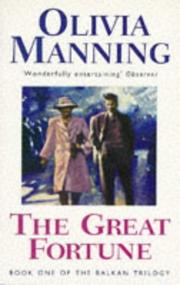
Start with The great fortune. It is the first novel Olivia Manning published in the sequence, it opens in Bucharest in the autumn of 1939 with Guy and Harriet Pringle arriving as newlyweds who barely know each other, and everything in the remaining five books depends on the marriage established in its first fifty pages. There is no reason to begin anywhere else.
The obvious alternative is to start with one of the two collected volumes, since the six novels are usually sold as a Balkan Trilogy omnibus and a Levant Trilogy omnibus. That is a perfectly good way to buy them, and worth knowing before you order, because our catalogue lists the six novels individually and you may end up with duplicates. The other tempting shortcut is to skip to the desert-war material in the later books, and that one genuinely does not work: those chapters get their force from three volumes of accumulated domestic tension you would not have read.
Publication order and chronological order are the same here, which removes the argument that complicates most series. Manning wrote the six over twenty years, in sequence, following the war as it moved. Read them in the order she wrote them.
The Balkan Trilogy
The great fortune is Bucharest in the phoney war, an English expatriate community drinking and gossiping while Romania slides toward the Axis. The spoilt city continues as the political situation deteriorates and the Pringles' position becomes untenable. It is the slowest book of the six and the one most readers find hardest to push through, largely because it is a novel about waiting; the pay-off is real but it arrives in the next volume. Friends and heroes moves the story to Greece, and the fall of Athens gives Manning the ending the trilogy has been building toward.
The Levant Trilogy
The danger tree picks up in Egypt and introduces Simon Boulderstone, a young British officer heading for the Western Desert. This is the structural change that divides readers. Some think the desert chapters are the best writing Manning ever did and the thing that lifts the sequence from a good expatriate novel into a war novel; others find them an intrusion into a story that was working perfectly well as a marriage. Both reactions are common and neither is wrong.
The battle lost and won covers El Alamein and is the most conventionally gripping volume. The sum of things closes the sequence, moving toward Damascus and toward the end of the war, and it gives the Pringle marriage the resolution the whole sequence has been withholding.
What you are getting into
These are novels almost without plot in the usual sense. Things happen, but the engine is Harriet's steadily sharpening view of her husband: Guy is generous, idealistic and endlessly available to everyone except her, and a reader who wants him to be likeable will spend six books being annoyed. Most readers find that this is the point rather than a flaw. The books are also closely autobiographical, drawn from Manning's own war years with her husband Reggie Smith, which accounts for both the precision and the settling of scores.
One honest note about the perspective. The narration sits inside a British expatriate world and reproduces its casual condescension toward Romanians, Greeks and Egyptians. Readers disagree about how much ironic distance Manning keeps from that outlook, and it is a live critical question rather than a settled one. It is worth going in aware of it.
Where to stop
After Friends and heroes is a legitimate stopping point. The Balkan Trilogy is a complete work with its own arc, and many readers stop there satisfied. If you continue and find the Boulderstone chapters do not hold you, the marriage narrative in the Levant volumes is easy to follow on its own — but do not stop after The battle lost and won, which ends mid-movement. Either finish the sequence or end at the third book.
There is also a well-regarded 1987 television adaptation of the whole sequence, which is worth watching afterwards rather than before, since it resolves the Pringles into faces very firmly.
Six books, roughly two thousand pages, one of the best fictional records of the Second World War from outside the fighting. Read them in the order above.
Follow the full ordered path here: Fortunes of War by Olivia Manning Reading Order: Where to Start.