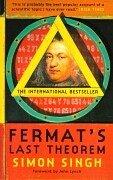
Start with Simon Singh's Fermat's Last Theorem, the 1997 narrative history that took the problem from a mathematical curiosity to a household story. It is reporting rather than mathematics: Singh interviewed Andrew Wiles and most of the surviving cast, and the book carries the emotional arc of the 1993 announcement, the discovered gap, and the 1994 repair with Richard Taylor. It was published in the United States as Fermat's Enigma, which is the same book under a different jacket.
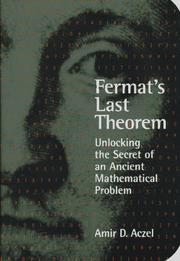
Before going further, a warning about this particular list, because three separate books here are catalogued under almost exactly the same display title. Singh's is the narrative. Fermat's last theorem by Amir D. Aczel is a shorter popular account from 1996 that sketches more of the mathematical machinery and does much less reporting. Fermat's last theorem by Harold M. Edwards is something else entirely — a Springer graduate text subtitled a genetic introduction to algebraic number theory, which develops Kummer's ideal theory and assumes you are comfortable with rings, fields and Galois theory. Ordering the wrong one is the single most common mistake with this subject.
The popular accounts
Read Singh. Aczel overlaps him substantially and is thinner on the human story while not going far enough into the mathematics to replace a textbook, so if you are reading only one popular treatment, skip it. Its one genuine advantage is compression — it will give you the shape of the Taniyama-Shimura conjecture in an afternoon.
Building the actual background
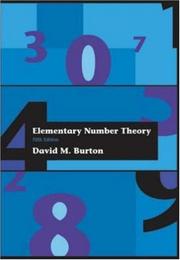
Elementary number theory by David M. Burton is the standard undergraduate first course: divisibility, congruences, quadratic reciprocity, and enough of Fermat's own work to see where the problem came from. It assumes only comfort with reading and writing proofs, and it is the correct starting point for anyone who wants the mathematics rather than the story.
A Classical Introduction to Modern Number Theory by Kenneth F. Ireland and Michael Rosen is the step up, and it is a genuine step: algebraic number fields, zeta functions, an introduction to elliptic curves, all assuming a solid abstract algebra course. Number Theory: An approach through history from Hammurapi to Legendre is André Weil's historical treatment, written by one of the twentieth century's major number theorists. It looks like a history book and is not one — Weil reconstructs the arguments of Fermat and Euler in modern terms and expects you to follow them. Read it beside Ireland, not before.
The classical attack, which never worked
Fermat's last theorem by Edwards is the serious book on the nineteenth-century approach: cyclotomic fields, ideal numbers, regular primes, and Kummer's proof for a large class of exponents. It is a graduate text and it is also the best available account of how the problem shaped algebraic number theory. Understand clearly that this route does not reach Wiles. 13 lectures on Fermat's last theorem by Paulo Ribenboim surveys the same classical territory and was published in 1979, so it predates the proof entirely; it is a valuable record of what was known before modularity, and a poor guide to what finally worked. Algebraic Number Theory and Fermats Last Theorem by Ian Stewart and David Tall — catalogued here without the apostrophe — is the friendliest bridge of the three, moving from undergraduate algebra to the classical results and then gesturing at the modern proof.
Toward the real proof
Fearless symmetry by Avner Ash and Robert Gross is the unusual book that explains Galois representations and reciprocity to a reader without a graduate background, and it is the best single preparation for understanding what Wiles actually proved. Rational Points on Elliptic Curves by Joseph H. Silverman and John Tate is an undergraduate introduction to elliptic curves; The arithmetic of elliptic curves is Silverman's graduate standard on the same subject and the reference everyone in the field owns. A first course in modular forms by Fred Diamond and Jerry Shurman goes directly at the modularity theorem, and is the book to read if you want to see the statement Wiles proved in its natural setting.
Invitation to the mathematics of Fermat-Wiles by Yves Hellegouarch is a guided route to the proof for a strong graduate reader, and Hellegouarch's own curve construction is part of the story. Modular Forms and Fermat's Last Theorem, edited by Gary Cornell, Joseph Silverman and Glenn Stevens, is the conference volume that lays out the proof in full. It is research-level and collaborative, and no one reads it casually.
Be honest with yourself about the destination. The proof is roughly a hundred pages resting on decades of machinery, and reaching it takes several years of graduate mathematics. Stopping after Singh, or after Burton, or after Fearless symmetry are all perfectly respectable places to stop. Browse Discover if the number theory rather than the theorem is what caught you.
Follow the full ordered path here: Fermat's Last Theorem: The Best Books to Read, in Order.