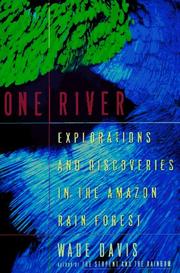
Start with One River. Wade Davis wrote it as a double biography — his own Amazon fieldwork alongside that of his teacher Richard Evans Schultes, the Harvard botanist who spent twelve years in the Colombian Amazon — and it is the best argument anyone has made for why this discipline exists. It is also long and genuinely a narrative, so it carries readers who would bounce off a textbook. Tales of a Shaman's Apprentice by Mark Plotkin, another Schultes student, is the shorter and more accessible version of the same experience.
Davis's earlier The Serpent and the Rainbow is the famous one and needs a caveat. Its central claim — that Haitian zombification involved a preparation containing tetrodotoxin — was contested hard by toxicologists after publication, and the pharmacological argument is not accepted. The ethnographic material on Vodou society is more durable. The 1988 horror film that took the title has nothing to do with the book.
The core textbooks
Plants, People, and Culture by Michael Balick and Paul Alan Cox is the standard accessible introduction to the field — a Scientific American Library volume, well illustrated, covering plant use across food, medicine, materials and ritual, and the right first non-narrative book. Read it before anything technical.
Two books here are titled Ethnobotany and they are completely different. The one edited by Richard Evans Schultes, with Siri von Reis, is a large multi-author survey of the discipline itself — its history, its subfields and its methods, chapter by chapter, closer to a handbook than a textbook. Gary Martin's Ethnobotany is the field methods manual: how to design a study, run interviews, take vouchers, quantify use, and handle consent and compensation. If you intend to do fieldwork, Martin is the one you need.
Applied ethnobotany by Anthony Cunningham is the conservation-facing companion to Martin, built around participatory work with harvesting communities and the sustainability of wild collection.
The Schultes shelf
Three more books carry his name and they do distinct jobs. Plants of the gods, with Albert Hofmann, is the illustrated survey of psychoactive plants and their cultural use — the most widely read book on that subject and the one most often misused as a manual, which it is not. Vine of the soul, with photographs, is a visual record of Amazonian healers and ayahuasca use. The healing forest, with Robert Raffauf, is a technical flora of medicinal and toxic plants of the northwest Amazon — a reference work organised by family, to be consulted rather than read.
Medicinal plants of the world by Ben-Erik Van Wyk and Michael Wink sits alongside them as the general illustrated reference: species by species, with the active constituents and the documented uses, and it is unusually careful about distinguishing traditional use from tested activity.
Say the obvious thing once, plainly. Documented traditional use of a plant is evidence about a culture, not evidence that a preparation is safe or effective for you. Dose, preparation, species identification and drug interactions all matter, several plants in these books are lethal, and none of this replaces a clinician or a qualified herbal practitioner.
The wider frame
Braiding Sweetgrass by Robin Wall Kimmerer is essays rather than science writing — a botanist who is also a member of the Citizen Potawatomi Nation, holding scientific and indigenous knowledge alongside each other rather than translating one into the other. It has become the most read book on this list by a wide margin. The botany of desire by Michael Pollan flips the perspective to the plants, following the apple, the tulip, cannabis and the potato as species that have used human desire to spread.
Both are worth reading after the core, because they raise the question the older books mostly do not: who owns knowledge collected in the field. Benefit-sharing, prior informed consent and the Nagoya Protocol are now central to ethnobotanical practice, and some of the classic collecting described admiringly in the narratives would not be conducted the same way today.
Follow the path in order and the field methods will land on a foundation rather than in a vacuum.
Follow the full ordered path here: Ethnobotany Books: Where to Start and What to Read Next.