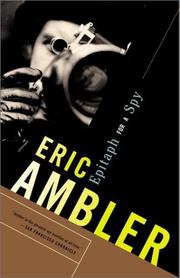
Start with Epitaph for a Spy, then read The Mask of Dimitrios. Do not start at the beginning of the bibliography; the 1936 debut is a parody and a false impression of what this writer does.
Epitaph for a Spy is the purest statement of the Ambler formula in the shortest space. A stateless Hungarian language teacher develops his holiday photographs at a French resort, finds military installations on his film, and is given a choice between prison and unmasking whichever of the other guests is the actual spy. That is the shape of modern spy fiction as most people now understand it: not a professional on a mission, but an ordinary man — an engineer, a teacher, a journalist — who steps off the path once and finds himself inside somebody else's intelligence operation with no training and no way out. Both Graham Greene and John le Carré pointed back here.
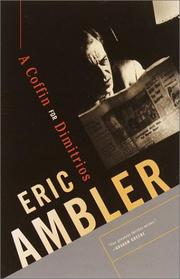
The Mask of Dimitrios is the masterpiece and the reason to read second rather than first. A detective novelist reconstructs the life of a dead Balkan criminal and discovers that European politics between the wars ran on exactly this kind of man. It works best once you know the formula, because it is Ambler abandoning the formula for something closer to documentary. It was published in the United States as A Coffin for Dimitrios, which our catalogue holds as a separate record of the same novel — buy one.
The rest of the pre-war run
Ambler wrote five novels in five years before 1940 and they made his name. Uncommon danger is the first fully formed one: a broke freelance journalist takes a courier job in Austria and becomes the disposable middle of an oil-concession conspiracy. It makes the Soviet agents the sympathetic professionals and an arms cartel the villain, an inversion nobody else was writing in 1937 — the anti-fascist politics in these books are explicit. It was sold in America as Background to Danger, again a separate record here.
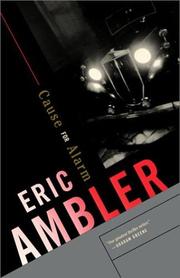
Cause for alarm runs the same machinery at higher pressure: an English engineer takes a job in Mussolini's Italy for the salary and finds his predecessor was murdered, and the escape across the Yugoslav border is the best sustained sequence he wrote before the war. Journey Into Fear is the most claustrophobic — an armaments engineer shot at in Istanbul and put on a small Italian steamer with the assassin aboard. Read it last of the four.
The post-war return
After an eleven-year silence Ambler came back writing about occupation, decolonisation and the mechanics of the coup rather than about approaching war. Judgment on Deltchev is the correct first of these: a British playwright covers a show trial in an unnamed Eastern European state, and the early sympathy for the Soviet side is gone — a shift that cost him admirers at the time and is exactly why it is worth reading here.
The Schirmer inheritance traces a missing heir through occupied Germany into the Greek civil war, swapping the innocent-caught-up-in-it plot for a genuine investigation; the historical texture is the strongest in his work. State of Siege traps an engineer in a hotel through a coup in a newly independent South-East Asian country, and begins the subject that occupied the rest of his career. It was published in Britain as The Night-Comers, so once again, pick one. Passage of arms sends a hidden arms cache through a chain of entirely reasonable people to an entirely unreasonable end, and is his funniest serious book.
The late comic phase
The frightened innocent is replaced by a small-time crook who is out of his depth through his own fault, and readers divide on whether that is a decline or the point. The Light of Day is the pivot and the one to read first here: Arthur Abdel Simpson, a petty Cairo hustler blackmailed into driving a car full of weapons into Istanbul, narrating self-servingly and very funnily. It was filmed as Topkapi. The Levanter — a Syrian businessman forced to host a Palestinian guerrilla operation in his own factory — is the best of the late novels and the closest to the pre-war work. Doctor Frigo is cool, patient and the most novelistic thing he wrote, and a good place to stop.
The two for completists
The dark frontier, the 1936 debut, has a concussed physicist who believes he is a fictional secret agent and behaves accordingly. It was written as a parody of the Buchan-style thriller Ambler despised, and reads as a young writer working out what he did not want to do — read it late, when the joke is legible. Here Lies is the autobiography and the right last book: the East End childhood, the advertising job that taught him plotting, the wartime film unit, and his own flat account of why he wrote the early novels as he did.
Ambler published eighteen novels and this list is deliberately selective; the omissions, including the collaborations written as Eliot Reed, are lesser work rather than victims of space.
Follow the full ordered path here: Eric Ambler books in order: where to start with the pre-war spy novels.