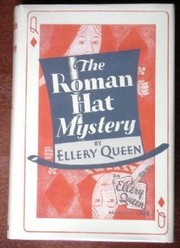
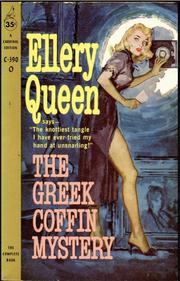
Start with The Greek coffin mystery. This is one of the rare series where beginning with the first published book is a mistake: The Roman Hat Mystery (1929) is stiff, over-long and buried in footnotes, and it has turned away more readers than any other entry. The Greek novel, published in 1932, is the best pure puzzle the authors ever built — four successive solutions, each convincingly demolished by the next — and, conveniently, it is set earlier in the fiction's internal chronology than the books that preceded it, so nothing is spoiled by starting there.
Before the sequence, the name. Ellery Queen was two cousins from Brooklyn, Frederic Dannay and Manfred Lee, writing under a pseudonym they also gave to their detective — the byline and the sleuth are the same person, which was a marketing decision and a very effective one. Dannay generally built the plots and Lee wrote the prose. Nothing on the spine tells you any of this.
The nationality novels
The early books are titled to a formula and are strict fair-play puzzles, each containing a "Challenge to the Reader" — a page on which the authors stop the story to state that you now have every fact Ellery has.
The Greek coffin mystery (1932) first, for the reasons above. Then The Chinese Orange Mystery (1934), which contains the most famous locked-room-adjacent image in the whole run: a dead man in a room where everything, including his clothing, has been turned backwards. The explanation is fair and it is superb.
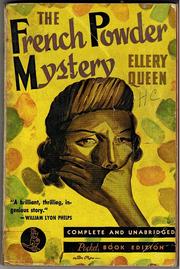
Then go back for The French powder mystery (1930), which has one of the great last-line revelations in the genre, and The Roman Hat Mystery (1929) last, once you like the authors enough to forgive the machinery. Reading the first book fourth is unusual advice and we mean it.
The change of direction
Around 1942 the cousins abandoned the formula completely, and this is the real division in their work. The nationality titles stopped, the deductive apparatus was subordinated to character and setting, and the books became something closer to novels.
Calamity town (1942) is where that begins and is the best-loved book they wrote. Ellery arrives in the small New England town of Wrightsville to write, and stays for a poisoning case that is as much about the town as the crime. Several later novels return there.
Cat of Many Tails (1949) is the peak of the later manner: a serial strangler working through New York during a heatwave, a city sliding towards panic, and an Ellery who has lost confidence in his own method after an earlier failure. It is a genuinely dark book and it is the one most likely to impress a reader who thinks Golden Age detection is a game with no stakes.
Where to stop, and a warning about the later paperbacks
Six books is a complete education: the four nationality novels above, plus Calamity town and Cat of Many Tails. That covers both halves of the career.
Be careful further on. From the early 1960s a large number of paperbacks appeared under the Ellery Queen name that the cousins did not write — they were produced by other hands, among them Avram Davidson, Theodore Sturgeon and Jack Vance, working from outlines or entirely independently. Some are good books; none of them are what you came for. If you go past this path, check the publication year and the reputation of the individual title before buying.
The full ordered path with stage notes is below.
Follow the full ordered path here: Ellery Queen books in order: where to start with the nationality mysteries.