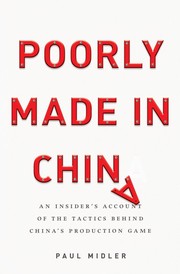
Start with The Party (2010) and Poorly made in China (2009): one explains who actually decides things, the other shows what that means on a factory floor. Between them they cover the two failures that catch foreign firms most often — misreading where authority sits, and assuming that an approved specification is a permanent one.
The reason to be careful about order here is that this subject dates faster than almost any other on the site. The China a foreign company dealt with in 2005 — cheap labour, loose enforcement, a central government actively courting investment — is not the China of the mid-2020s, and a tactical manual written for the first will mislead you about the second. Every title below carries its year for that reason. Structural books age well. Etiquette manuals and market-entry playbooks age badly.
How the system works
The Party (2010) is Richard McGregor's anatomy of Communist Party control over enterprise, personnel and the state. It explains the mechanism that most other books on this list only describe the effects of, and the thing it describes has become more true since publication rather than less. Red capitalism (2011) is the harder companion: Carl Walter and Fraser Howie worked inside Chinese finance and take apart the banks, the bad-debt vehicles and the equity markets. It assumes real financial literacy. China's great wall of debt (2018) is the readable successor, carrying the same argument through shadow banking, local government financing vehicles and the property boom.
Cracking the China conundrum (2017) is the necessary dissent. Yukon Huang, a former World Bank country director for China, argues that the standard narrative of debt crisis and unsustainable investment misreads the data, because Chinese figures do not mean what their Western equivalents mean. He may be wrong. Reading him after Walter and McMahon is still the fastest way to find out whether you understood their case or merely absorbed it.
What it feels like from inside
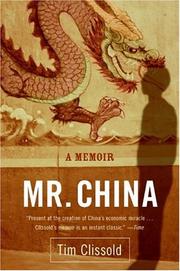
Poorly made in China (2009, revised 2011) is Paul Midler's account of years as a sourcing intermediary, and the source of the phrase quality fade — the deliberate, incremental degradation of a product after the samples are signed off. It is the most quoted book here among people who actually import things. Mr. China (2004) is Tim Clissold's memoir of losing most of a $400 million fund across 1990s joint ventures; it is very funny and it is a catalogue of every control assumption that did not hold. Chinese Rules (2014) is his follow-up, framed around strategic maxims and a carbon-credit venture, and is the weaker book.
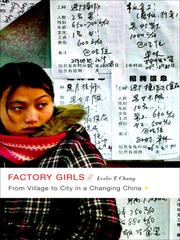
Factory Girls (2008) is the one to read if you want to understand the workforce rather than the counterparty. Leslie Chang followed young migrant women in Dongguan over several years, and her picture of ambition, churn and self-invention corrects most of what the coverage of that decade implied. Age of ambition (2014) does something similar at national scale, through individual lives.
The dated practical shelf
Read these knowing what they are. One Billion Customers (2005) is James McGregor's case-study collection on negotiating, regulators and joint ventures: sharp on principles, obsolete on specifics. China CEO (2006) is built from interviews with multinational executives and is a snapshot of that cohort's thinking. China, Inc (2005) is a journalist's account of China's rise written for an American readership anxious about it, and now reads as a period document. Chinese business etiquette (1999) is a protocol manual, and protocol is the fastest-dating material of all. The End of copycat China (2014) argued the low-cost imitator model was already finished, which was early and broadly right.
One honest gap: nothing here covers the last decade properly — the tightening after 2015, the 2017 intelligence legislation, exit bans, the pandemic years, the technology crackdown, or the 2023 counter-espionage revisions and the raids on due-diligence firms. Fill that with current reporting rather than assuming a book from 2014 anticipated it. For the enforcement and fraud side of the same terrain, see corporate fraud and business scandals.
Follow the full ordered path here: Doing Business in China: The Best Books, in Order.