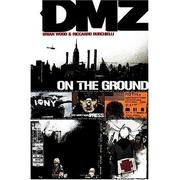
Start with DMZ Vol. 1. There is no chronological alternative and no better entry point: DMZ ran for 72 issues between 2005 and 2012, the collected trades follow the issues in sequence, and volume one drops you into Manhattan beside a photojournalism intern who has just worked out that nobody is coming to extract him. His disorientation and yours are the same disorientation, and that is deliberate construction rather than a rough opening.
The usual alternative — start with the volume readers name as the best, which is normally the run of standalone character issues in the middle — throws away the thing that makes those issues work. They are portraits of people you have already been taught to navigate a city alongside. Read in isolation they are good short comics; read in place they are the argument of the series.
What DMZ actually is
The premise: a second American civil war has stalled, with the United States government holding one side of the river and the secessionist Free States the other, leaving Manhattan as the demilitarised zone between them. A few hundred thousand people never left. Matty Roth arrives as an intern on a network news crew, the crew is killed, and he stays — first because he cannot get out, then because he has become the only reporter inside. Brian Wood wrote it, Riccardo Burchielli drew most of it, and it was published by Vertigo. It is a war comic about journalism, and specifically about the point at which a reporter stops describing a conflict and starts being a participant in it.
Volumes one to five
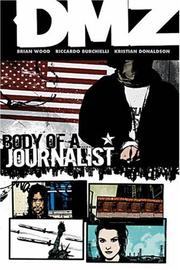
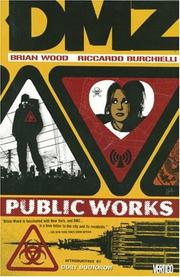
DMZ Vol. 1 establishes the geography and the premise through Matty's first days. DMZ Vol. 2 is where he stops being a tourist and starts filing, and where the series sets up the ethical questions it spends the rest of its run testing. DMZ Vol. 3 widens the lens from Matty to the civilians who actually live in the zone, which is the point at which the series' real subject arrives. DMZ Vol. 4 is the standalone-issues volume — separate portraits rather than a war arc, and the strongest single argument for the book's quality, but it depends on the geography the first three volumes built. DMZ Vol. 5 brings the two armies and the political machinery around the ceasefire to the front, and sets up everything the later books escalate.
The gap: volumes six to ten
This list holds five of the twelve trades plus the final two. Volumes six through ten have no usable record in our book catalogue under any edition convention we could find, and rather than pad the path we have left the hole visible. That is a gap in our data, not in the series, and it covers a lot of story — the elections arc and the war-crimes material that reframe Matty entirely. If you want the complete run in one consistent format, the practical workaround is to ignore the twelve-volume numbering and read the five collected DMZ Deluxe hardcovers instead, which reprint the whole series without a gap. Pick one numbering scheme and stay inside it; mixing the two is how people buy the same issues twice.
The ending
DMZ, Vol. 11: Free States Rising turns the Free States from an offstage abstraction into a movement with a history and a founding, and it is the setup for the finale. DMZ, Vol. 12: The Five Nations of New York resolves Matty's story and the war together. Both are catalogued here under their full volume titles rather than the bare form used for the earlier trades. Volume twelve is written as a summation, so it remains worth reading even across the gap — you will lose the immediate cause of Matty's situation but not the shape of the judgement the series passes on him.
Brian Wood's other war books
Channel Zero is his late-1990s comic about a media activist in an authoritarian New York, and visibly the seedbed DMZ grew from. Read it after DMZ rather than before, so the ideas are legible in their rougher first form. Rebels is an American Revolution series about ordinary people conscripted into a war of secession — DMZ's question asked two and a half centuries earlier, and the natural next book if the civilian focus was what held you.
Honest warnings
The violence is frequent and unglamorous, and the series depicts massacres, torture and the use of civilians as political material. It is also explicitly political: the parallels to Iraq-era American foreign policy are drawn on purpose and are not subtle. Readers who want a neutral war story will not find one here. More comics reading lives on Discover.
Follow the full ordered path here: DMZ Reading Order: Where to Start Brian Wood's Second American Civil War Comic.