Two things make this reading list harder than it looks. The books come from two genres that are easy to confuse — empirical research and practitioner advocacy — and several of the field's most quoted findings are weaker or more disputed than their popular versions suggest. A reading order that puts the contested evidence first, with the disputes labelled, makes everything after it easier to weigh.
The single most consequential finding for practice is also the least often repeated in the popular books: the research on mandatory unconscious-bias training, notably Frank Dobbin and Alexandra Kalev's analysis of decades of firm-level data, found that such training generally did not increase managerial diversity and sometimes coincided with declines. Structural changes — recruitment targeting, mentoring, accountability for outcomes — performed better. Start from that and the rest of the field sorts itself.
Where the evidence is genuinely contested
Blindspot by Mahzarin Banaji and Anthony Greenwald is the popular account of implicit bias and the Implicit Association Test, written by two of the test's creators. Read it, and read it knowing the state of the argument: meta-analyses, including work by Oswald and colleagues and later by Forscher and colleagues, find that IAT scores predict individual behaviour only weakly, and that shifting implicit measures does not reliably shift behaviour. That is not a claim that bias does not exist; it is a claim that the test is a poor diagnostic for any particular person, which its own authors have acknowledged.
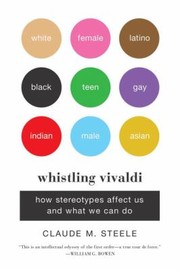
Whistling Vivaldi is Claude Steele's account of stereotype threat, and it is the best-written book on this list. The replication picture is mixed rather than settled: some large replication attempts and meta-analyses adjusting for publication bias find effects much smaller than the early studies reported, while other researchers maintain the effect holds under specific conditions. Both positions are held by serious people, and the article you read on it will usually tell you only one.
The person you mean to be by Dolly Chugh is the behavioural-science bridge from those findings to individual conduct, aimed at people who consider themselves fair and want to know what that is worth. Diversity, Inc. is Pamela Newkirk's journalistic counterweight — a reported account of how much American organisations have spent on diversity programmes and how little measurable change resulted. It is an indictment rather than a study, and it names names.
Designing systems instead of training people
What works by Iris Bohnet is the most useful book here for anyone with authority over a process, because it treats bias as something to design around rather than train away: structured interviews, comparative evaluation, blind review, changed job-advertisement language. One caution — its famous opening example, the claim that blind auditions dramatically increased women's hiring in orchestras, rests on a study whose statistics have been challenged by later reanalysis, with critics arguing the data are too noisy to support the headline effect. The book's broader argument does not depend on that one case, but the case is repeated everywhere as settled and it is not.
Bias Interrupted by Joan Williams is the operational version: metrics, small process changes, and interrupting bias where decisions are actually made. The Memo by Minda Harts is written to women of colour navigating workplaces rather than to the organisations, and it is candid in a way the leadership books are not. Invisible Women by Caroline Criado Perez widens the frame beyond the office to the data gap itself — crash-test dummies, drug trials, urban planning, phone sizes — and is the most heavily sourced book on this list.
Practice books, read as practice
Subtle Acts of Exclusion by Tiffany Jana and Michael Baran is the practical handbook on naming and responding to everyday exclusion in the moment. Inclusify by Stefanie Johnson, Inclusion on Purpose by Ruchika Tulshyan and How to Be an Inclusive Leader by Jennifer Brown cover overlapping ground for managers; they differ in emphasis rather than substance, so pick the one whose framing fits your organisation instead of reading all three.
The Difference and Diversity Bonus, both by Scott Page, close the path with the formal argument that diverse groups can outperform more able homogeneous ones on certain problem types. It is worth reading carefully: Page's models are about cognitive diversity — different heuristics and representations — and the inference from that to demographic diversity is a further step he is more careful about than many people who cite him.
Employment law, pay equity and discrimination complaints are matters for qualified legal and HR advice, not for a reading list. Browse related subjects or follow the ordered path below.
Follow the full ordered path here: Diversity and Inclusion at Work: Books Worth Reading, in Order.