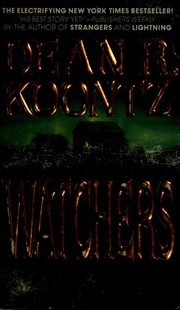
Start with Watchers. It is the book Koontz readers name most often when asked, it stands completely alone, and it does the thing he does better than anyone in his category: it takes a premise from the cheap end of the shelf — two creatures escape a government lab, one of them a golden retriever with human intelligence — and plays it entirely straight, with real tenderness and a genuinely frightening antagonist.
Publication order is close to useless here. Koontz has published well over a hundred novels since the late 1960s, many of the early ones under pseudonyms, and the first two decades are apprentice work he later disowned, rewrote or quietly let go out of print. There is no arc to follow and no continuity to protect. What you need is a route through the books worth reading, which is what this list is.
The core run
Whispers is the 1980 novel where the modern Koontz appears — the suspense tightens, the prose stops straining, and the psychology of the villain carries the book. From there, Phantoms strands a small Californian town with something very old underneath it, Strangers assembles half a dozen unconnected people who are all breaking down for the same buried reason, Watchers is the peak, and Lightning is the oddest of the group, a time-travel thriller whose reveal is better withheld. Cold Fire belongs with them. Any of these five can be read first; none of them requires the others.
If you want a pure thriller
Intensity is the one. It is short, it runs close to real time, there is nothing supernatural in it at all, and it is the leanest thing Koontz has written — a woman in a house, then a motorhome, then a farm, with a killer she cannot get away from. Most readers who bounce off his sentimental register get on with this one. The violence is severe and the pace is deliberately airless.
The Odd Thomas books
Odd Thomas is a fry cook in a Mojave desert town who can see the dead and cannot speak to them. It is the most distinctive voice in Koontz's work and it launched a seven-book sequence with a real ending. Read them in order: Odd Thomas, Forever Odd, Brother Odd, Odd Hours, then Odd Apocalypse, Deeply Odd and Saint Odd, the last three of which are not in this list and will need to be found elsewhere. The order matters more here than anywhere else in his work — this is one story, the losses accumulate, and the final book resolves the first.
The sprawling ones
From the Corner of His Eye and Life Expectancy are the books where Koontz stops writing thrillers and writes something closer to a fable, with coincidence treated as design and a comic tone doing the heavy lifting. Life Expectancy — a baker whose grandfather predicted five terrible days of his life — is the more controlled of the two. Readers who find his sentimentality hard going should skip both.
Two entries that need a warning
Demon Seed is from 1973 and was substantially rewritten in 1997. It is a novel about an artificial intelligence that imprisons a woman in her own house in order to force a pregnancy, and the sexual violence is the plot rather than an incident in it. It is an outlier, not a representative early work, and it is a bad first Koontz. The Frankenstein sequence is represented here by an omnibus of the first three novels, Frankenstein: Prodigal Son among them; the sequence continues in Lost Souls and The Dead Town, which are not on this list.
Honest warnings and where to stop
The house formula is visible once you have read four or five: a decent person, an implacable evil with no interest in negotiation, a dog, and an ending that affirms rather than complicates. Later novels lean harder on that affirmation and on an explicitly spiritual frame, which readers either want or badly do not. The 1970s pseudonymous output is not worth hunting down. If Watchers, Intensity and Odd Thomas do not land, the rest will not either — try something else on Discover.
Follow the full ordered path here: Dean Koontz books in order: where to start.