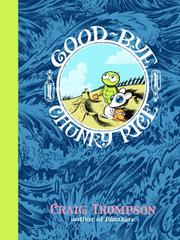
Start with Good-bye, Chunky Rice. It is under a hundred and thirty pages, it is a fable about a turtle leaving his best friend to go to sea, and it teaches you to read Thompson's page layouts before you meet six hundred of them. His brushwork, his wordless pages and the specific way he draws snow and water all arrive fully formed in this book, carrying almost no narrative weight — which is exactly why it prepares you for the one that carries all of it.
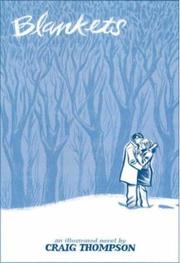
The obvious alternative is Blankets, and it is a reasonable choice; it is the famous book and it reads in an evening despite its length. But it is autobiography — an evangelical childhood in rural Wisconsin, a first love at church camp, and a slow separation from faith — and the emotional demands it makes land better when you already trust the drawing. Read it second.
The early work and the breakthrough
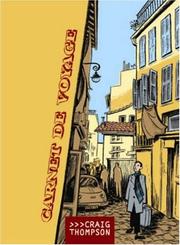
Good-bye, Chunky Rice first, Blankets second, then Carnet de Voyage third. The last of those is a sketchbook diary of the European and Moroccan book tour Thompson took after Blankets, drawn on the road and reproduced as-is. It is the most direct access anyone has to how he works, and it is where the research and the visual obsessions that became his next book start showing up on the page.
Habibi, and the argument about it
Habibi took seven years: two escaped slaves in an invented Middle Eastern landscape, built around Arabic calligraphy, Quranic and Biblical narrative, and geometric ornament. It is the most beautiful object he has made, and it drew serious criticism on publication for orientalism — for staging a fantasy Middle East of harems, eunuchs and slave markets, drawn by an outsider working from a Western tradition of exactly those images. Defenders answered that the book is deliberately built out of storybook material and signals its own artifice throughout, and that its treatment of Islamic narrative is reverent rather than dismissive. That dispute is not settled and this guide does not settle it. Read the book and read the criticism; both are part of its reception, and being able to state the objection accurately is more useful than picking a side before you have looked.
The rest of the shelf
Space dumplins is a full-colour children's science-fiction adventure about a girl searching for her father through a galaxy of space whales and garbage. It is slighter than everything around it and reads as a deliberate change of register after seven years on Habibi. Ginseng Roots is the return to memoir, drawn over five years: the ginseng farms of central Wisconsin where he and his brother worked as children, the crop's route to Asia, and his own relationship with his family and his hands. It is the best thing he has done since Blankets and the natural place to finish.
What to read next
Thompson is shelved beside a small group of books that defined graphic memoir, and reading them against him is the most rewarding thing to do with the rest of your time. Fun Home is the direct comparison — far more formally controlled, annotated and literary where Thompson is fluid. Maus I is the book that made the form possible; our catalogue holds the first volume separately, though it is usually sold with the second as The Complete Maus. Epileptic is the closest match to Blankets in subject, a childhood inside a total worldview, and completely different in drawing.
Then push further out. The Complete Persepolis is the strongest counterexample to Thompson's lushness — flat black and white with no shading at all — and it is useful reading against Habibi for obvious reasons. Stitches does what Thompson does with wordless pages, more severely. Jimmy Corrigan is the most formally radical book here, diagrammatic and cold. Asterios polyp uses a different drawing style for each character's perception, which makes it the clearest demonstration on this list that in comics the style is the argument.
More graphic-novel reading paths are on Discover.
Follow the full ordered path here: Craig Thompson Reading Order: Where to Start With His Graphic Memoirs.
Ready to learn something deeply?
Build a reading path — free