Cleopatra is one of the best-documented famous people in the ancient world and one of the least reliably documented. Not a line she wrote survives. The narrative everyone knows comes through Plutarch and Cassius Dio, writing a century and two centuries after her death, drawing on material shaped by the propaganda of the man who destroyed her. Read the popular biographies first and you absorb that shape without noticing it.
The order below is designed to work against that. A good narrative first, so you have the story. Then a second and third biography that show how differently the same scraps can be read. Then the Egypt underneath her — a Greek-speaking Macedonian dynasty that had ruled the country for nearly three centuries by the time she was born, and which she was reportedly the first of her line to bother learning the local language of.
Start with one biography, not three
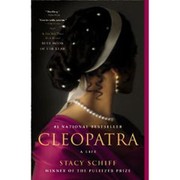
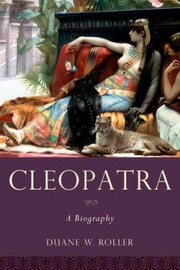
Stacy Schiff's Cleopatra is the entry point: a bestselling narrative life, elegantly written, careful to flag where the record runs out. Duane Roller's Cleopatra A Biography, published as Cleopatra: A Biography, is the shorter scholarly counterpart, drier and stronger on the Hellenistic political context. Joyce Tyldesley's Cleopatra is the Egyptologist's version, and it is the one most interested in her as a pharaoh rather than as a figure in Roman politics.
These three cover the same life. Read one properly, then a second for the contrast, and skip the third unless the subject has taken hold of you. Schiff plus Tyldesley is the most useful pairing, because the gap between a literary biographer and an Egyptologist tells you more about the evidence than either does alone.
Adrian Goldsworthy's Antony and Cleopatra is the double biography and the best single book on the political and military story. Goldsworthy is a Roman historian, so Rome is the centre of gravity — read him for the war and the alliance, not for Egypt.
Then the country she actually ruled
Michel Chauveau's Egypt in the age of Cleopatra is the pivot of this list. It reconstructs daily life, administration, religion and law in the last Ptolemaic century from papyri rather than from Roman literature, and after it the biographies read differently. Sally-Ann Ashton's Cleopatra and Egypt is the more compact treatment of the same problem, focused on how she was represented in Egyptian and Greek imagery.
Sarah Pomeroy's Women in Hellenistic Egypt widens the frame to the women whose documented lives make Cleopatra look less singular and more like the extreme case of a real pattern. Naphtali Lewis's Greeks in Ptolemaic Egypt does the same for the Greek settler population, through individual case studies drawn from documentary evidence.
Alexandria and the wider Hellenistic world
Justin Pollard's The rise and fall of Alexandria is the popular history of the city — the Museum, the scholars, the lighthouse. It is a good read and it repeats several of the dramatic stories about the Library that specialists treat with caution.
Which is why The Library of Alexandria by Roy MacLeod belongs after it. This is an edited academic volume rather than a narrative, and it is where you find the sober version: the Library's decline was probably gradual and multi-causal, and the single catastrophic burning is a much later and much-repeated story rather than a documented event. If you want to know what is actually known, this is the book, and it will not entertain you the way Pollard does.
Peter Green's Alexander to Actium is the last and largest item, a survey of the entire Hellenistic age of nearly a thousand pages. It is not a book to read straight through at this stage; it is the reference you keep once the period has your attention, and it places the Ptolemies among the other successor kingdoms.
What to expect
Expect disagreement rather than resolution. Whether Cleopatra was a shrewd dynastic politician making the only alliances available to her, or a ruler who gambled her kingdom on two Roman men, is a live argument among serious historians, and the sources are thin enough that both readings survive contact with the evidence. The reading order above lets you form your own view instead of inheriting Augustus's. Work through the full sequence on the Cleopatra and Ptolemaic Egypt hub.
Follow the full ordered path here: Cleopatra and Ptolemaic Egypt: Books to Read, in Order.