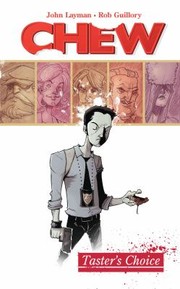
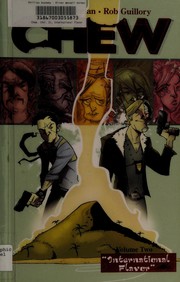
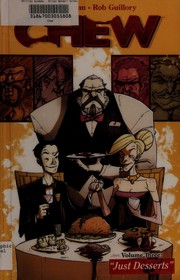
Start with Chew, Vol. 1 and read the twelve volumes in numerical order. There is no chronological alternative, no recommended skip and no better entry point — the series ran sixty issues from 2009 to 2016, John Layman plotted it to a fixed ending from the start, and the trades follow the issues in sequence.
That simplicity is the whole answer to the order question, so here is the more useful information: what the series is, where it changes, and the one purchasing mistake people make.
What it actually is
Tony Chu is a cibopath. He gets a psychic impression from anything he eats — where it came from, what happened to it, and in the case of a person, everything that happened to them up to the moment of death. He therefore solves murders by eating the victims. He works for the Food and Drug Administration, which in this world is the most powerful law-enforcement agency in the United States after a bird flu killed millions and chicken was banned outright.
It is a comedy first. Rob Guillory draws it in a rubbery, exaggerated style packed with background gags, sight jokes and running signage, and a real part of the reading experience is scanning panels for material that has nothing to do with the plot. It is also genuinely a horror comic, and the gap between those two registers is the point.
The tonal turn
Chew, Vol. 1 through Chew, Vol. 4 are broadly episodic: a case, an escalation, a new absurd food-based power. Somewhere around Chew, Vol. 5 and Chew, Vol. 6 the conspiracy plot — the flu, the alien writing in the sky, the question of what actually happened — moves to the front, and the series stops being funny in the same way.
Chew, Vol. 7 onward is where readers who signed up for a gross-out comedy get caught out. Major characters die, and they die badly and permanently, and the book expects you to have been laughing at them for five volumes first. Most readers find this the strongest stretch of the run; a minority never forgive it. Chew, Vol. 8, Chew, Vol. 9, Chew, Vol. 10 and Chew, Vol. 11 run the endgame, and Chew, Vol. 12 closes it, resolving the flu plot and the sky-writing.
The collected-edition trap
Image reprinted the series in larger hardcovers that each collect two of the twelve trades, and there are also omnibus-scale editions. They are good books, but the numbering is different — a hardcover marked one contains what the trades call volumes one and two. Pick a single format and stay in it. Mixing the twelve-volume numbering with the collected numbering is how people end up buying the same issues twice, and the volume titles are not similar enough to catch the overlap at a glance.
Honest warnings
The central premise is cannibalism used as a forensic tool, and it is drawn, not implied. There is a lot of vomit. The humour is broad and occasionally juvenile, and the series is aimed squarely at adults despite the cartooning. If the first volume's tone does not work for you, the series does not later become subtler — it becomes darker while keeping the same jokes.
Where to stop
Nowhere. Twelve volumes is not a long commitment, the ending was planned rather than improvised, and stopping partway leaves the central mystery unresolved with no partial payoff. If you are going to bail, bail after Chew, Vol. 1 — that volume tells you accurately what the next eleven are like. Other completed comic series are listed on Discover.
Follow the full ordered path here: Chew Reading Order: Where to Start and What Order to Read It In.