Start with Seven Brief Lessons on Physics. It is about eighty pages, it was originally a newspaper column, and it will settle in an afternoon whether Rovelli's manner works for you — lyrical, compressed, philosophical, quite happy to leave an equation out. Readers either find that clarifying or find it evasive, and there is no point discovering which after buying four books.
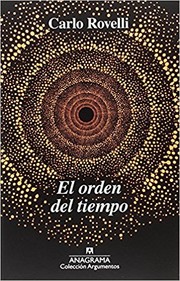
The obvious alternative is Order of Time, published as The Order of Time, which is his most loved book and the one most often recommended. Read it second, not first. It makes an unusual claim — that time as we experience it is not fundamental to physics — and it lands far harder if you already have the sketch of modern physics that Seven Brief Lessons on Physics provides.
The popular books, in order
Seven Brief Lessons on Physics, then Order of Time, then White Holes, which is the shortest and strangest of the three: a single speculative idea, what happens at the end of a black hole's life, followed to the end. It is closer to a prose poem than a survey, and it is best read when you already trust him.
Reality Is Not What It Seems is the substantial one. It is the full argument, from Democritus through general relativity and quantum mechanics to loop quantum gravity, and it is the book to read if you want to understand what Rovelli actually works on rather than what he muses about. If you only read one full-length Rovelli, make it this.
Helgoland is the quantum mechanics book, built around Heisenberg's summer on a windswept island and around Rovelli's own relational interpretation, in which properties exist only in relation to other systems rather than absolutely.
Two things are worth saying plainly here. Loop quantum gravity is a real, serious research programme and it is also a minority one; string theory attracts far more researchers, and neither approach has experimental confirmation. Rovelli is an advocate writing about his own side of an open question, and he is candid about that. Likewise, the relational interpretation of quantum mechanics is one of several competing interpretations, not a consensus.
There Are Places in the World Where Rules Are Less Important Than Kindness is the outlier: a collection of essays and journalism on Newton, Nabokov, drugs, anarchism and the rest. Read it if you like the voice.
The books that argue back
Sean Carroll's Something Deeply Hidden covers the same quantum territory as Helgoland and reaches a very different conclusion — Carroll argues for the many-worlds interpretation, in which the wave function never collapses and every outcome happens. Rovelli's relational view and Carroll's many-worlds view are incompatible, both are held by working physicists, and the question is genuinely open. Reading them back to back is the single most useful thing in this path.
Lee Smolin's Three Roads to Quantum Gravity is older and comes from a fellow loop-quantum-gravity researcher, so it is not a rebuttal so much as a second voice from the same camp. It remains one of the clearest popular accounts of why quantum mechanics and general relativity cannot both be right as they stand.
The cliff
Quantum Gravity, published in the Cambridge Monographs on Mathematical Physics series, and Covariant Loop Quantum Gravity are graduate textbooks. They are listed here because they are the real work behind the popular books, not because they are a next step. They assume general relativity, quantum field theory and a good deal of differential geometry. If you have that background they are the destination; if you do not, no amount of enthusiasm for Reality Is Not What It Seems will get you through chapter two, and that is not a failing on your part.
Where to stop
Most readers should stop after Helgoland, having read four books and understood a genuinely contested corner of physics from the inside. Add Something Deeply Hidden to hear the other case. Go to the textbooks only with the mathematics already in hand. More physics sequences are on Discover.
Follow the full ordered path here: Carlo Rovelli Reading Order: Which of His Physics Books to Read First.