Start with Ramona the Pest. The book that comes first by publication is Beezus and Ramona, and it is the obvious choice for exactly that reason, but it is told from the point of view of the older sister, Beatrice, and Ramona in it is a four-year-old obstacle rather than a person. Ramona the Pest is the first book written from inside Ramona's head, it puts her in kindergarten, and it is the funniest entry point Cleary ever wrote.
For the adult choosing here: these are children's novels of the plainest sort, first published between 1950 and 1999, set on one street in Portland, Oregon, and built almost entirely out of small domestic problems — a lost tooth, a substitute teacher, a father who quits smoking, a family that cannot afford much. There is no fantasy, no peril and no moral instruction. What there is, and what has kept them in print for seventy years, is an unusually exact ear for how humiliating ordinary childhood is.
The Ramona books, in order
Read Beezus and Ramona, Ramona the Pest, Ramona the Brave, Ramona and Her Father, Ramona and Her Mother, Ramona Quimby, Age 8, Ramona Forever and Ramona's World in that sequence. Publication order and internal chronology agree, which settles the usual argument before it starts: Ramona ages from four to nearly ten across the eight books, and reading them out of order means watching her get younger.
Ramona and Her Father and Ramona Quimby, Age 8 are Newbery Honor books and are the two most people remember. The first is built around Mr Quimby losing his job; the second contains the raw-egg scene that anyone who read these as a child can still describe. Ramona Forever handles a wedding, a death in the family and a new baby. Ramona's World was published in 1999, fifteen years after the previous book, and reads as a coda rather than a continuation.
If you are reading aloud, note that Beezus and Ramona is the weakest of the eight and putting it first has lost more than one household. Starting at Ramona the Pest and going back to it later costs nothing.
Where Henry Huggins fits
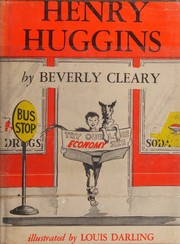
Henry Huggins was the first book Cleary published, in 1950, and it established the neighbourhood the Ramona books share; Ramona first appears in it as a minor nuisance. Henry and Beezus follows. They are looser and more episodic than the Ramona books — a boy, a dog, a paper route, a scheme — and their 1950s texture now reads as period: children roam unsupervised, money is counted in dimes. Our catalogue holds the first two; the rest of the run, including Henry and Ribsy, Henry and the Paper Route, Henry and the Clubhouse and Ribsy, is not in it.
Read them after Ramona, or between Ramona books. Nothing in the Ramona sequence depends on them.
The other books
The Mouse and the Motorcycle is a separate animal fantasy for younger readers — a mouse, a toy motorcycle, a hotel — and is the entry point to a trilogy whose sequels, Runaway Ralph and Ralph S. Mouse, are not in our catalogue.
Dear Mr. Henshaw is the outlier and the best book Cleary wrote. It won the Newbery Medal in 1984, it is told in letters and diary entries by a boy whose parents have divorced, and it is quiet, sad and completely unsentimental. It is pitched a few years older than Ramona and is the right thing to hand a reader who has finished her. Strider is its sequel and is gentler.
A Girl From Yamhill is Cleary's own memoir of an Oregon childhood, written for adults and older readers; a second volume, My Own Two Feet, continues it. Read it last, if at all — it is a good book that explains where the others came from. More children's reading paths are on Discover.
Follow the full ordered path here: Beverly Cleary books in order: where to start with Ramona.