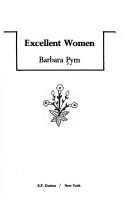
Start with Excellent Women. It is her second published novel and her best, and Mildred Lathbury — a clergyman's daughter in her thirties who makes tea for other people's crises and is not asked what she thinks about anything — is the character the rest of the work orbits.
The obvious alternative is Some Tame Gazelle, which came out two years earlier and is the first novel she published. It is charming and it is slighter: two middle-aged sisters and the curates they variously admire, written when Pym was in her twenties imagining herself old. Start there and you get the furniture without the intelligence. Excellent Women has both, and it establishes at once that these are not cosy books — the comedy is being made out of a woman watching her own life be treated as a utility.
The comic novels, in order
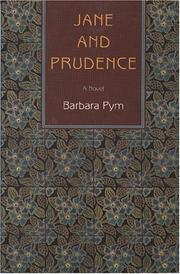
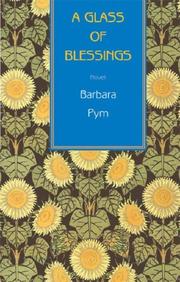
Excellent Women, then Jane and Prudence, then Less than angels, then A Glass of Blessings.
Jane and Prudence pairs a scatty vicar's wife with a beautiful younger friend who has unsuitable affairs, and contains Pym's funniest sustained joke about how much better men eat than women. Less than angels moves out of the parish into a research institute and is her novel about anthropologists — she worked at the International African Institute for years, and the sight of academics studying kinship rituals while entirely failing to notice their own is the whole book. A Glass of Blessings is narrated by the least self-aware of her heroines, a rich and idle married woman who spends the novel misreading everyone around her, including a pair of men whose relationship is obvious to the reader and invisible to her. Many long-standing Pym readers name it her finest.
Then go back for Some Tame Gazelle. Read fifth it is a delight; read first it is a costume.
The late book
Quartet in Autumn (1977) is the one to end on and never to begin with. Four office workers approaching retirement, two men and two women, share a room and almost nothing else. It is short, and it is bleak in a way none of the earlier books prepare you for — loneliness treated as fact rather than as material for comedy. It was shortlisted for the Booker.
The circumstances matter. Pym had been dropped by her publisher in 1963 and spent sixteen years unable to place a novel. In 1977 the Times Literary Supplement asked writers to name the most underrated author of the century, and she was the only person named twice, by Philip Larkin and by Lord David Cecil. The rediscovery followed within months, and Quartet in Autumn was the book that arrived on the back of it. Read it knowing that, and the flatness reads as earned rather than as decline.
Several of her novels are not in our catalogue — among them A Few Green Leaves, No Fond Return of Love and An Unsuitable Attachment, the book whose rejection began the wilderness years. None of them is the place to start, but they exist and are worth finding once the six here are done.
What Pym does not offer
Nothing much happens. There are jumble sales, unsatisfactory lunches, and a great deal of tea. Readers who need plot find her unbearable and are not wrong about the facts, only about whether that is a defect. What she offers instead is a very cold eye inside a very polite sentence — the reason Larkin admired her, and the reason the label cosy is the single most misleading thing said about her.
Where to stop
Three novels give you the writer: Excellent Women, A Glass of Blessings and Quartet in Autumn, read in that order, which takes you from the joke to the joke turning. Add Jane and Prudence and Less than angels if the first three land.
More twentieth-century fiction is on Discover.
Follow the full ordered path here: Barbara Pym Reading Order: Where to Start with the Comedies of English Parish Life.