Start with Complications. It is his first book, it is a set of essays rather than a thesis, and it is the one where a surgeon admits on the page that he does not know what he is doing yet. Everything Gawande wrote afterwards is an attempt to answer questions this book only raises — how do you get good at something dangerous, and what do you do about the parts medicine cannot fix.
The obvious alternative is Being Mortal, which is the famous one and the best written. If you have arrived here because someone you love is seriously ill, go straight to it and do not wait; it is the book people actually need. For everybody else, reading it fourth rather than first turns it from a moving book into the conclusion of an argument.
These are books by a doctor, not medical advice. Nothing here substitutes for a conversation with the clinicians treating you or a person you care for.
The four, in order
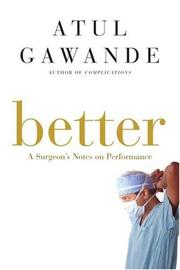
Complications is essays on uncertainty: the surgeon in training, the autopsy, the cases that went wrong. Better is the follow-up and asks what separates adequate performance from excellent performance — handwashing rates, battlefield survival, cystic fibrosis clinics that quietly outperform every other clinic in the country. It is the least famous of the four and the most practically useful if you work in any high-stakes field.
The Checklist Manifesto is the one that escaped medicine entirely and became a business book. The argument is that expertise fails predictably under complexity and that a short, dumb, well-designed checklist catches what expertise misses. One honest caveat: the surgical safety checklist study that anchors the book showed dramatic results, and a later large population study in Ontario found no significant mortality benefit. The debate over why the results did not replicate is live and unresolved, and it is worth reading the book with that in view rather than as settled science.
Being Mortal is the last of the four and the one that changed practice. It is about what medicine does to the end of life when its only mode is intervention, and about the questions a doctor should ask instead. It is unsentimental and it is hard to read in the wrong week.
The shelf around him
If Gawande worked, these are the books to go to next, and they are not more of the same.
When Breath Becomes Air by Paul Kalanithi is a neurosurgeon's account of his own terminal diagnosis, written while dying and finished by his wife. Do No Harm by Henry Marsh is the British counterpart to Complications, and it is angrier and more openly guilt-ridden about the operations that ended badly. How We Die by Sherwin Nuland predates Gawande and is the more clinical, less consoling treatment of the same ground as Being Mortal.
The House of God by Samuel Shem is the outlier: a savage 1970s comic novel about medical internship that is still passed hand to hand by residents. It also carries the sexism and the contempt for patients of its era, undisguised, and readers coming to it new are often startled. It matters as a document; it is not a model.
What Patients Say, What Doctors Hear by Danielle Ofri turns the lens onto the consultation itself. An American sickness by Elisabeth Rosenthal explains why the American bill looks the way it does, which is the structural story Gawande mostly leaves alone. Knocking on heaven's door by Katy Butler is a daughter's account of a father kept alive by a pacemaker nobody revisited, and it is the personal version of Being Mortal.
Where to stop
Read all four Gawande books; there are only four and none is padding. Then pick one from the shelf above based on what you want — When Breath Becomes Air for the personal, An American sickness for the system. More health and medicine sequences are on Discover.
Follow the full ordered path here: Atul Gawande in Order: Which of His Four Books to Read First.