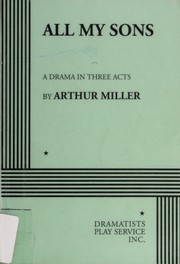
Start with All My Sons. It is a tight, conventional, three-act family play about a manufacturer who shipped defective aircraft parts during the war, and it is the last time Miller wrote inside the rules. Read it first and you can see exactly what he broke two years later. It is also short, plainly constructed, and the easiest Miller to read on the page rather than watch.
The obvious alternative is to open with Death of a Salesman, and if you are only ever going to read one Miller play, read that one. But Death of a Salesman moves between present and memory without warning, and its power comes partly from how violently it departs from the well-made play. Coming to it directly from All My Sons gives you that departure for free.
The core four
All My Sons, then Death of a Salesman, then The Crucible, then A View from the Bridge. That is the sequence almost every Miller reader should follow, and it covers roughly a decade of his work.
One note on The Crucible. It is a play about the Salem trials written during the McCarthy hearings, and it is deliberately not a documentary. Miller aged Abigail Williams up from eleven to seventeen and invented the affair that drives the plot. Read it as a play about denunciation and self-preservation, not as history — and if you want the actual trials, that is a different reading list.
A View from the Bridge is the one people underrate. A Brooklyn longshoreman, two illegal immigrant cousins, a narrator borrowed from Greek tragedy. Read the two-act version if you have a choice.
The middle plays
After the Fall is where readers divide. It is a memory play about a man reviewing his marriages, and it was read at the time as a barely disguised account of Miller's own marriage to Marilyn Monroe, who had died shortly before. Critics attacked it on those grounds; Miller denied that reading for the rest of his life. The dispute is part of the play's history and you should know it exists, but it is not the only thing in the play.
Incident at Vichy is a single-act interrogation scene in occupied France, and it is the most concentrated argument he ever staged. The price puts two estranged brothers in an attic full of their dead father's furniture and is, for a lot of readers, the best of the late work. The American clock is his Depression panorama and the least focused of these. Broken glass is the late one worth finding: a woman's hysterical paralysis in 1938 Brooklyn, set against Kristallnacht.
The prose
Focus is a novel, not a play — an early book about an American who starts being taken for Jewish after he gets glasses, and about how quickly his neighbours turn. It is less accomplished than the plays and more direct than any of them.
The Misfits was written as a screenplay and published as what Miller called a cinema novel, which makes it a strange reading experience: film grammar on the page. Read it if the Nevada material interests you, skip it otherwise.
Finish with Timebends, the autobiography. It is long, unchronological and self-serving in places, as autobiographies are, but it is the only place he explains his own working method at length.
Where to stop
Four plays is a complete Miller for most readers: All My Sons, Death of a Salesman, The Crucible, A View from the Bridge. Add The price if you want the mature work, and Timebends if you want the man. Other twentieth-century drama sequences are on Discover.
Follow the full ordered path here: Arthur Miller in Order: Where to Start with the Plays.